
Introduction
Parallel resistor
If two or more resistors are connected together in a head-joint, tail-to-end manner, it is a parallel connection of resistors. Resistors in parallel can be equivalent to one resistor. As shown in the picture below:
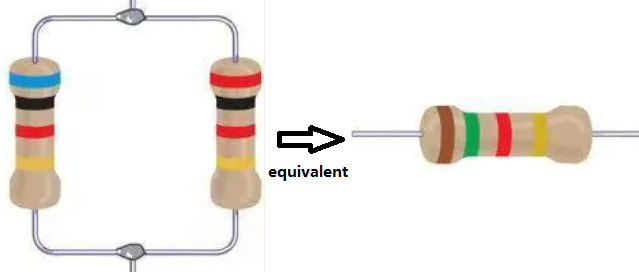
figure 1:Resistors in parallel can be equivalent to one resistor
Parallel resistor calculation formula
The parallel circuit is a common circuit connection mode. As can be seen from the example above, the main feature of the parallel circuit is that each component is connected first and end to end. After the resistors are connected in parallel, the total resistance decreases. We can use the following formula to calculate the size of the resistance:
If only two resistors are connected in parallel, the following formula is used:
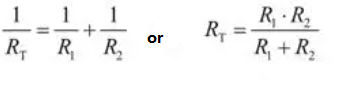
If three or more resistors are connected in parallel, the following formula is used:
The following is a parallel circuit diagram
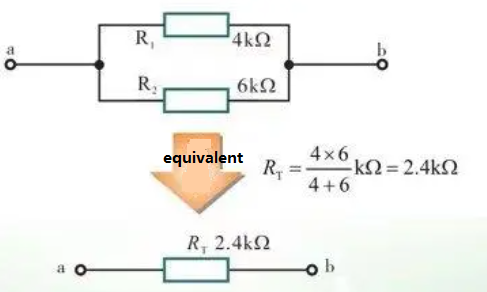
Parallel resistor of current and voltage
A parallel resistor circuit has such a feature: in a parallel resistor circuit, the voltage at both ends of each resistor is the same, but the current flowing through each resistor is different. That is, the resistance is small, the current flowing through the resistance is large; When the resistance is large, the current flowing through the resistance is small. The formula is as follows:
The total current is equal to the sum of the currents:
I=I1 I2
The voltage is equal everywhere:
U1=U2=U
Applications of Parallel Resistors
1. Increased Total Current Carrying Capacity
In circuits where handling large currents is necessary, multiple resistors can be connected in parallel to avoid excessive current flowing through a single resistor value. Parallel resistors can share the current load in the circuit, thereby increasing the total current carrying capacity.
2. Voltage Divider
Unlike series resistors, parallel resistors can be used to achieve voltage division. By connecting resistors in parallel, the total resistance of the circuit can be altered, thus achieving the desired voltage output.
3. Protection Against Resistor Failure
In certain applications, if one resistor fails, it may impact the functionality of the entire circuit. To mitigate this risk, parallel resistors can be used. In case one resistor fails, the other parallel resistors will continue to provide the circuit with the required resistance.
Series Resistor
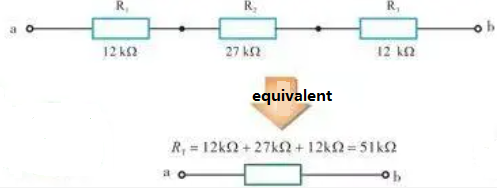
If several resistors are connected end to end, as shown in Figure 1, it is a series of resistors. Resistors in series can be equivalent to one resistor. As shown in the picture below:
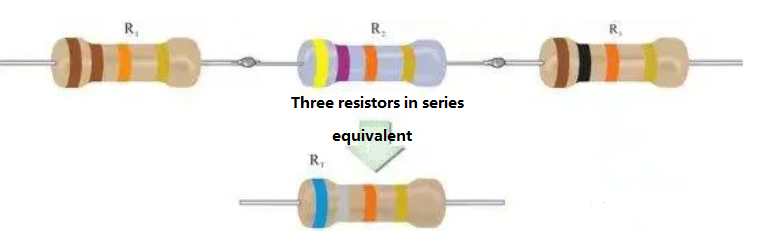
figure 2: Three resistors in series can be equivalent to one resistor
Series Resistor Calculation Formula
As can be seen from the above diagram example, connecting the ends of adjacent resistors is the essential element of series connection. When resistors are connected in series, the total resistance increases. The total resistance of series-connected resistors is equal to the sum of the resistance values of all resistors connected in series, which is represented by the formula:
RT = R1 R2 ... Rn
Here is a series circuit diagram:
Current and Voltage in Series Resistors
A characteristic of series resistor circuits is that in a series resistor circuit, the current flowing through each resistor is the same; however, the voltage across each resistor is different. That is, if the resistance is small, the voltage across the resistor is small; if the resistance is large, the voltage across the resistor is large. The formulas are as follows:
Current is the same at each point:
I1 = I2 = I
Total voltage is equal to the sum of individual voltages:
U = U1 U2
Applications of Series Resistors
1. Voltage Divider Circuit
Series resistors can be used to construct voltage divider circuits. Voltage divider circuits are used to lower the voltage to the required level to meet the operational requirements of electronic components. By adjusting the ratio of series resistors, the desired voltage output can be obtained.
2. Expansion of Resistance Range
Since the resistance range of a single resistor is limited, in some applications, there is a need to achieve a wider range of resistance adjustment. In such cases, series resistors can be used to expand the range of resistance, thereby meeting practical requirements.
3. Reduction of Resistance for Current Flow
In certain situations, to reduce the resistance for current flow, series resistors can be employed. For example, in circuits where limiting the current flow is necessary, but direct modifications to the power source or other components are not feasible due to specific requirements. In such cases, increasing the number of series resistors can reduce the resistance for current flow.
More resistor calculators:
LED Series Resistor Calculator - a tool used to determine the value of a series resistor needed in an LED circuit to regulate the current flowing through the LED.
Reactance Calculator - The formula associated with AC frequency and circuit inductance and its reactance is calculated.