
What is pressure
Pressure is the force per unit area, typically expressed in Newtons per square meter or Pa. Pressure can also be expressed in many other units that are commonly related to force and area.
Common Units of Pressure Measurement
The pressure unit derived from the International System of Units is the Pascal (Pa). Other commonly used pressure units in the SI system include Megapascal (MPa) and Kilopascal (kPa), while common non-SI pressure units include bar, atm, psi, mmHg, mmH2O, and others.
Pa:1Pa = 1 Newton / meter
hPa: 1 hPa=100Pa,commonly used in meteorology.
mbar: 1mbar = 100 Pa, is one of the standard units of pressure measurement.
atm: 1atm=101325Pa,commonly used in physics and aerospace.
Bar: 1bar=100 kPa
Psi: 1psi=6895 Pa
Torr:Equivalent to mmHg, a unit of pressure, 1 Torr= 1 mmHg
psi:Refers to the pressure exerted by one pound-force applied to one square inch, 1 psi=6894.76 Pa
Pressure Conversion Formulas
1 bar=100000 Pa 1 Pa =0.00001 bar
1 psi = 6894.76 Pa 1 Pa = 0.000145 psi
1 atm = 101325 Pa 1 Pa = 9.86923 x 10^-6 atm
1 Torr = 133.322 Pa 1 Pa = 1/133.322 Torr
1 hPa = 100 Pa 1 Pa = 1/100 hPa
Pressure Conversion Example
If there is a cylinder pipeline with an internal pressure of 15 bar, and it needs to be converted to the value in Megapascals (MPa), according to the above formula, we know that:
15bar=15×100000Pa=1500000Pa=1.5MPa
So, 15 bar = 1.5MPa
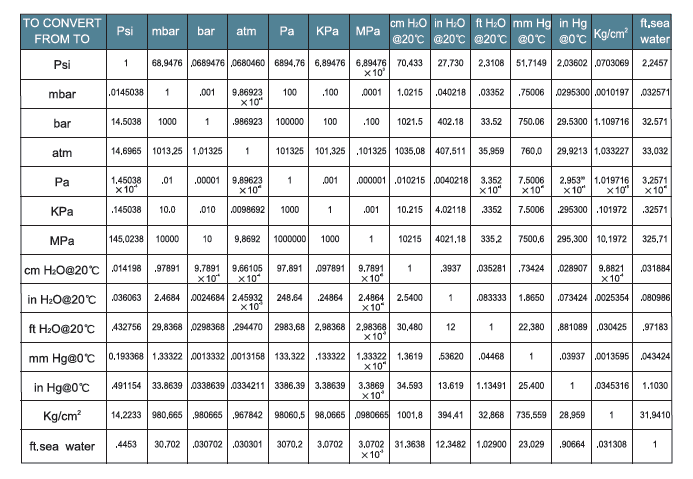
Pressure conversion table
Applications of Pressure Conversion
1. Engineering and Manufacturing: Pressure conversion is essential in industries such as aerospace, automotive, and manufacturing where precise pressure measurements are required for designing, testing, and quality control processes.
2. HVAC Systems: Pressure conversion is used in heating, ventilation, and air conditioning systems to ensure proper functioning and efficiency. Converting pressure measurements helps in maintaining optimal air flow and temperature control.
3. Medical Devices: Pressure conversion is important in medical devices such as blood pressure monitors, ventilators, and anesthesia machines. Accurate pressure measurements are crucial for patient care and monitoring.
4. Oil and Gas Industry: Pressure conversion is vital in the oil and gas industry for drilling operations, pipeline monitoring, and reservoir management. Converting pressure measurements helps in ensuring safe and efficient extraction processes.
5. Meteorology: Pressure conversion is used in meteorology to measure and analyze atmospheric pressure changes. Converting pressure readings helps in weather forecasting and understanding atmospheric conditions.
6. Research and Development: Pressure conversion is utilized in research laboratories for experiments, studies, and analysis where pressure-sensitive parameters need to be accurately measured and converted.
7. Environmental Monitoring: Pressure conversion is important in environmental monitoring applications such as water pressure measurement in oceans, lakes, and rivers, as well as atmospheric pressure measurements for climate studies.
Factors Affecting Pressure Conversions
1. Temperature: Pressure measurements can be affected by temperature variations, especially in gas systems where temperature changes can impact the volume and density of the gas. Temperature corrections may be needed for accurate pressure conversions.
2. Units of Measurement: Different units of pressure measurement (such as psi, kPa, bar, atm) can lead to confusion and errors if not properly converted. Using the correct conversion factors and formulas is essential to ensure accurate pressure conversions.
3. Calibration: The calibration of pressure measuring instruments and devices can affect the accuracy of pressure readings and conversions. Regular calibration and maintenance of equipment are necessary to ensure reliable pressure conversions.
4. Fluid Properties: The properties of the fluid or gas under pressure, such as viscosity and compressibility, can impact pressure measurements. Understanding the characteristics of the fluid is important for accurate pressure conversions.
5. Altitude: Pressure readings can vary at different altitudes due to changes in atmospheric pressure. Altitude adjustments may be required for pressure conversions in applications at high elevations.
6. Instrument Accuracy: The accuracy and precision of pressure measuring instruments can affect the reliability of pressure conversions. Using high-quality and properly calibrated instruments is crucial for accurate pressure measurements and conversions.
7. Environmental Conditions: Environmental factors such as humidity, air pressure, and ambient temperature can influence pressure measurements. Considering these conditions is important for accurate pressure conversions.
ALSO SEE:
Time Constant Calculator - JAK’s time constant calculator is a tool used to calculate the time constant of a system or circuit.
Voltage Divider Calculator - A voltage divider calculator is a tool used to calculate the output voltage of a voltage divider circuit based on the input voltage and resistor values.
Series and Parallel Capacitor Calculator - a tool or application for calculating equivalent capacitance values in series and parallel capacitor circuits.