
Introduction
Series capacitor
Series capacitors are two or more capacitors connected on a single line. The positive plate of one capacitor is connected to the negative plate of the next capacitor. Series capacitors can be represented as the following figure, where C1, C2, and C3 are the capacitors of a series connected capacitor.
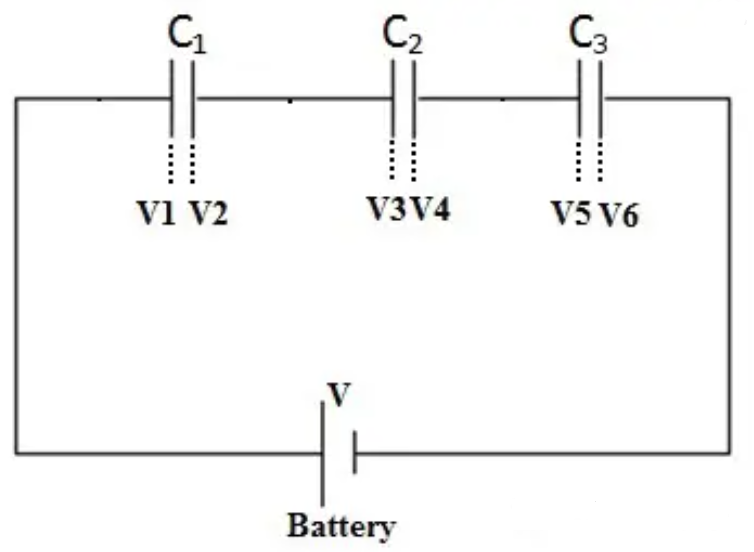
Series capacitor calculation formula
The equivalent capacitance value of a series capacitor is the reciprocal of the sum of the capacitance values, that is,
1/Ceq = 1/C1 1/C2 ... 1/Cn, where C1, C2,...
Where Cn is the capacitance value and Ceq is the equivalent capacitance of the series capacitor.
Application of series capacitors
1 Capacitors in series can increase the capacity and impedance of the circuit. When large-capacity capacitors need to be connected, multiple small-capacity capacitors can be connected in series to form an equivalent capacitor. At this time, the total capacitance is the sum of the capacity of each capacitor, and the capacity of the circuit will also increase. At the same time, the capacitor in series can reduce the impedance of the circuit and improve the response speed of the circuit.
2 capacitors in series can also protect the circuit. When the voltage is too high or the current is too large in the circuit, the capacitor can play a protective role to reduce the impact of voltage and current.
Parallel capacitor
If the capacitor is connected to the same two points of the circuit, the capacitor is in parallel. Parallel capacitors can be represented as the following figure, where C1, C2,... ,Cn is the capacitance of a capacitor connected in parallel.
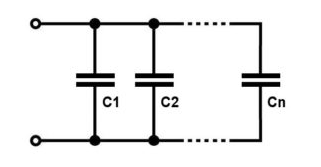
Parallel capacitor calculation formula
The equivalent capacitance value of the parallel capacitor is the sum of the capacitance values, that is,
Ceq = C1 C2 ... Cn,
Where C1, C2,... Where Cn is the capacitance value and Ceq is the equivalent capacitance of the parallel capacitor.
Parallel capacitor applications
1 In some DC power supplies, small capacitors with excellent ripple coefficients are used for better filtering. These are connected in parallel to increase capacitance values.
2 This can be used for large vehicles in the automotive industry, such as trams. These applications may require larger capacitance values than are typically available on the market.
The difference between series capacitors and parallel capacitors
In the circuit, the difference between series capacitors and parallel capacitors is mainly manifested in the following aspects:
1. The calculation method of capacitance value is different. The equivalent capacitance value of series capacitors is the reciprocal of the sum of all capacitance values, while the equivalent capacitance value of parallel capacitors is the sum of all capacitance values.
2. Different application scenarios, series capacitors are suitable for power factor correction, DC isolation, filtering and other occasions, while shunt capacitors are suitable for power modeling, noise filtering and other occasions.
3. Different connection methods, series capacitors are connected in a certain order to form an overall capacitor, while parallel capacitors are connected to the same power line at the same time to form a total capacitor.
ALSO SEE:
Energy Conversion - Energy conversion refers to the process of transforming one form of energy into another form.
Inductance Conversion - Inductance conversion refers to the process of converting inductance values between different units of measurement.
Length Conversion - Length conversion is the process of converting measurements of length from one unit to another.