
To reduce the size of the bulky inductive and capacitive components, wide-bandgap devices such as Gallium Nitride High-electron-mobility transistors (GaN E-HEMTs) have been stimulated.
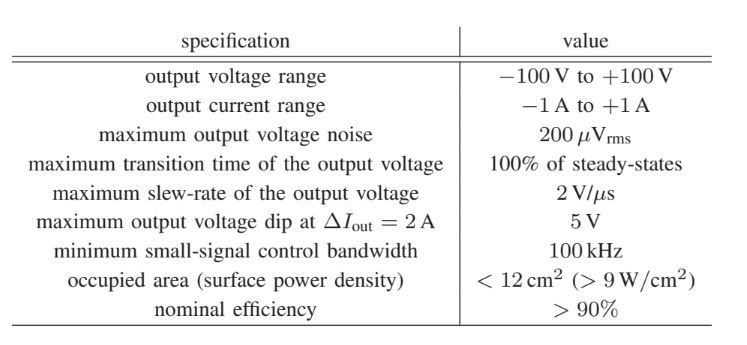
To reduce the size of the bulky inductive and capacitive components, wide-bandgap devices such as Gallium Nitride High-electron-mobility transistors (GaN E-HEMTs) were stimulated and it has been observed that high-switching frequency can be employed in few of the applications that usually work on the low-switching frequency, including the power factor correction system [2] and PV microinverters [3]. Efficiency of the converters having high-switching frequency is normally improved by the use of GaN devices, for example DC-DC converters for applications having RF tracking [4][5], generators with large signal and high frequency [6] and, finally, hybrid amplifiers with low-noise fast-tracking power supplies [7]. Advantages of these devices can be found in operations involving hard switching. That is due to low output capacitances and small turn-off losses. Table 1 shows the specifications of an arbitrary proposed (PWL) generator that has been designed on the basis of these specifications for the testing of the automotive equipment. This generator must provide 100W of output power continuously, along with the output voltage ripple that is very low (≤ 200 μVrms). Alternatives are necessary for the two-level buck converter because of the limited power loss budget and hardcore requirements for the voltage output ripple. A benchmark, hybrid-power amplifier, that has been presented in [7], is used to compare its performance with that of the switch-mode power amplifier. The system that has been designed has outperformed the conventional amplifier in all the situations. Here the IEEE original article.
ANPC Three-Level Converter
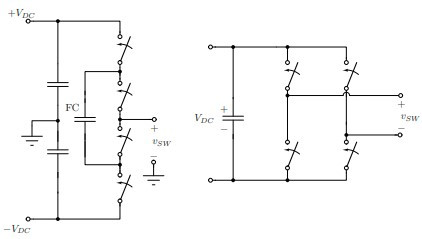
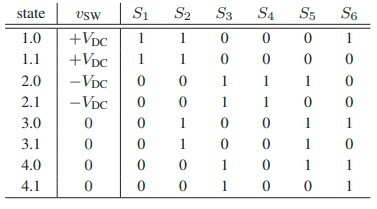
While operating in hard switching, optimization of the layout for minimizing the inductances of the parasitic stray is necessary for the high-frequency converters utilizing GaN devices. Undesirable breakdowns and overshooting of the power switches voltage are protected by this process [1]. Table 2 describes the eight switching states that are allowed for the converters. A three-level converter circuit is shown in figure 1. The impact of the switching frequency is shown in figure 2.
Optimized Design of ANPC Three-Level Converter
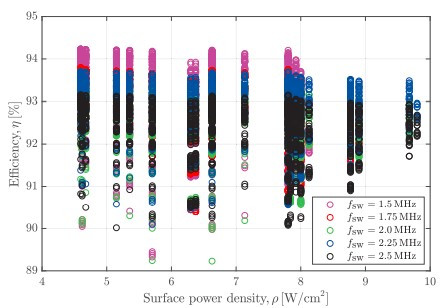
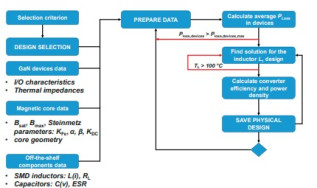
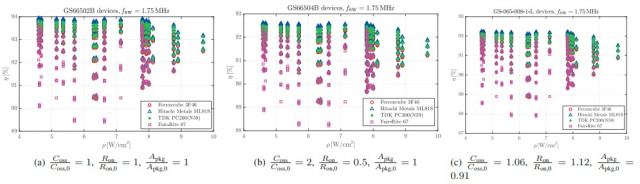
For proper and complete understanding and exploration of the boundaries of modern technology, optimization of the multi-objective (Pareto) is carried out. Development of the high-power density converters [9] is due to the advancements in the field of power electronics in the industrial research. Determination of the Pareto-optimal solutions has been done by performing the virtual prototyping. This included the variables of the systems such as switching technology and technological parameters for magnetic materials and devices [1]. Figure 3 shows the selection criterion. Output voltage, current and the switching frequency are the variables upon which the total power loss in the converters depends. The values of the ∆rds,on/∆Vds,on are greater in the EPC device case, as compared to the GaN system device case [1]. After analyzing the performances of all the devices, it has been observed that the GS66502B device has the most advantages [1]. Figure 4 clearly shows the Pareto plots for the GS66502B device, which is used as a base for the converter design along with the different switching frequencies to visualize the importance of the trade-off existing between the power density and efficiency of the converter.
Implementation and Experimental Results
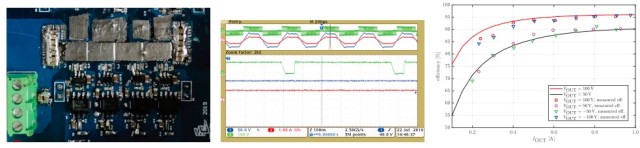
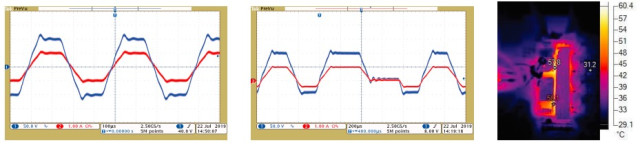
This procedure has been used for the design and fabrication of the PWL generator. Table 4 presents the hardware specifications of the implemented prototype [1]. Conduction of the cooling plates as a solid coolant agent, which is further combined with the forced air convection, is used for ensuring the safe and reliable operations of the power switches and the heat that is generated from the semiconductors is evacuated using this approach [1]. Figure 5 shows the prototype and the graphical representation of the switching waveform of the calculated and measured efficiency of the DC loading conditions from top side of the implemented ANPC three-level converter. Thermal camera images of the GaN devices and the performance of the PWL generator has been shown in figure 6.
Conclusions
The pre-described topology has been selected as a natural extension of a two-level inverter. Exploration of the limits of the present GaN technology and high-frequency magnetic materials has been done with the help of the design procedure that is automatized and which depends on multi-objective optimization. Moreover, it focuses only on the density of the power for the electrical parameters given. Optimal performance of the designed power converter is measured by the GS66502B GaN devices and ML91S ferrite core material variation of the device and magnetic parameters that are applied. The prototype has 100W and 1.75 MHz switching frequency. Extremely less thickness of the sheets makes the cooling system less space-consuming and the thermal management of the system is carried out with the help of the forced air cooling along with the cooling system. Surface power density of the system exceeds 9 W/cm2 because the total space utilized by the power transistors and two-stage output filter is less than 12 cm2.