
Electronic component procurement teams and compliance engineers face severe operational and regulatory risks when sourcing hardware for global markets. Procuring a component certified as RoHS-compliant does not prevent EU customs authorities from impounding a shipment under REACH regulations, nor does a general REACH declaration guarantee RoHS conformity.
| Regulation | Core Regulatory Divergence |
|---|---|
| EU RoHS Directive (2011/65/EU) | Product-level substance ban at the homogeneous material level (10 restricted substances; requires CE marking). |
| EU REACH Regulation (EC 1907/2006) | Horizontal chemical tracking across constituent articles (253 SVHCs; triggers Article 33 and SCIP reporting). |
This guide details the structural and legal distinctions between RoHS and REACH, the mathematical differences between homogeneous material calculations and the "Once an Article, Always an Article" (O5A) principle, mandatory reporting thresholds, the 2026–2027 lead exemption expirations, and the data verification frameworks required to protect electronic supply chains.
Fundamental Differences Between RoHS and REACH
EU RoHS and EU REACH govern environmental safety and chemical usage across the European Union, but they operate through different legal mechanisms, scopes, and enforcement models.
What is REACH compliances ? Difference between REACH & ROHS compliance and scope #REACH #pcbassembly
Regulatory Framework and Scope
EU RoHS (Directive 2011/65/EU[2], amended by Delegated Directive (EU) 2015/863, commonly termed RoHS 3) is a product-specific Directive. Because it is a directive, it requires transposition into the national legislation of each EU Member State. RoHS applies specifically to Electrical and Electronic Equipment (EEE) operating under designated voltage limits (up to 1,000 V AC and 1,500 V DC) across 11 defined product categories.
Conversely, EU REACH (Regulation (EC) No 1907/2006) is a Regulation. It applies directly across all EU/EEA Member States without requiring separate national implementing laws. REACH is horizontal in scope, regulating all chemical substances manufactured, imported, or used within the EU, whether standalone, within mixtures, or embedded inside physical products ("articles"). Consequently, every electronic component imported into the European Union falls under REACH, regardless of whether it meets a specific RoHS product scope exemption.
Substance Control Mechanism
The functional difference between the two frameworks lies in how they control hazardous chemistry:
- RoHS is a prohibitive mechanism: It establishes strict Maximum Concentration Values (MCVs) for 10 specific substances. If a non-exempt component exceeds these thresholds at the homogeneous material level, placing that product on the EU market is illegal. RoHS compliance is a direct prerequisite for affixing the CE mark.
- REACH is a risk-management and transparency mechanism: REACH operates on four functional pillars:
- Registration: Importers and manufacturers must register chemical substances produced or imported in volumes exceeding 1 metric ton per year.
- Assessment: EU Member State competent authorities and the European Chemicals Agency (ECHA) evaluate technical dossiers.
- Authorisation (Annex XIV): Substances of Very High Concern (SVHCs) are placed on a sunset track, requiring European Commission authorization for continued use.
- Restriction (Annex XVII): Specific hazardous substances are subjected to targeted bans or total concentration caps across designated applications.
Unlike RoHS, exceeding the 0.1% weight-by-weight (w/w) threshold for a REACH Candidate List substance in an electronic component does not trigger an automatic sales ban. Instead, it triggers legal transparency mandates, requiring suppliers to provide safe-use instructions to commercial customers (Article 33) and submit chemical dossiers to the ECHA SCIP database[4]. An outright ban under REACH occurs only if the substance and its specific application are explicitly listed under Annex XVII (Restrictions) or Annex XIV (Authorisation) past its designated sunset date.
Comparative Decision Matrix
| Compliance Dimension | EU RoHS (Directive 2011/65/EU 2015/863) | EU REACH (Regulation EC 1907/2006) |
|---|---|---|
| Legal Classification | Product Directive (Transposed by national laws) | Horizontal Regulation (Directly applicable EU law) |
| Regulated Scope | Electrical and Electronic Equipment (EEE) | All chemical substances, mixtures, and articles |
| Target Substance Pool | Exactly 10 restricted substances | 253 SVHC Candidate entries (plus Annexes XIV & XVII) |
| Measurement Denominator | Homogeneous material (mechanically separated) | Constituent article (CJEU Case C-106/14 "O5A") |
| Standard Thresholds | 0.1% (1,000 ppm) for 9 substances; 0.01% (100 ppm) for Cd | 0.1% w/w (1,000 ppm) per individual article |
| Primary Legal Consequence | Outright ban on placing non-compliant EEE on EU market | Mandatory B2B notification, SCIP entry, or use bans |
| CE Marking Linkage | Mandatory requirement for technical file & CE mark | Independent of CE marking (Separate legal compliance) |
| Technical Documentation | EN IEC 63000:2018 technical file required | Safety Data Sheets (SDS), FMD, and SCIP dossier IDs |
The Mathematics of Compliance: Homogeneous Materials vs. The O5A Principle
The primary reason components pass one regulatory framework while failing the other stems from how the chemical concentration denominator is defined. Compliance teams cannot average substance weights across an entire assembly.
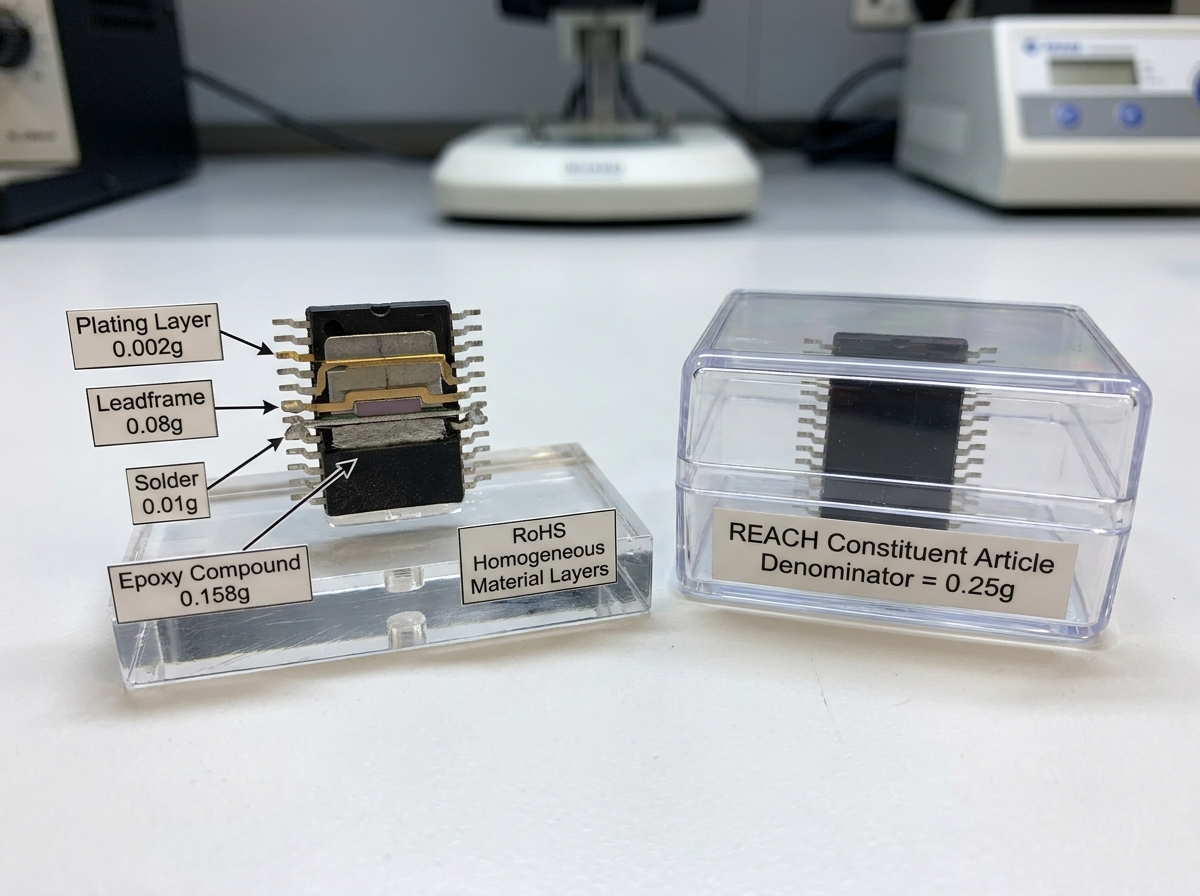
The RoHS Denominator: Homogeneous Material Level
RoHS defines a homogeneous material as one of uniform composition throughout or a material consisting of a combination of materials that cannot be disjointed or separated into different materials by mechanical actions such as unscrewing, cutting, crushing, grinding, or abrasive processes.
In an integrated circuit (IC), homogeneous materials include:
- The plastic or ceramic encapsulation molding compound
- The electroplated finish on the external leads (e.g., pure matte tin vs. tin-lead)
- The copper alloy base leadframe
- The internal die-attach adhesive or high-melting-point internal solder
- The silicon die and its passivation layers
Each layer must be isolated and evaluated independently. If the electroplating layer on a surface-mount diode contains 1,500 ppm of lead, the entire component violates RoHS, even if the lead represents less than 0.001% of the total component mass.
The REACH Denominator: "Once an Article, Always an Article" (CJEU Case C-106/14)
REACH defines an article as an object which during production is given a special shape, surface, or design which determines its function to a greater degree than does its chemical composition (Article 3(3)).
Historically, some importers attempted to calculate the 0.1% SVHC threshold by dividing SVHC weight by the weight of the total finished product (such as an entire 2 kg industrial controller). On September 10, 2015, the Court of Justice of the European Union (CJEU) issued its landmark ruling in Case C-106/14[3] (FCD and FMB), formally establishing the "Once an Article, Always an Article" (O5A) principle.
Under the O5A ruling:
- When an article is incorporated into a complex multi-component product, it remains an article under REACH.
- The 0.1% (w/w) SVHC notification and communication threshold applies to each constituent article assembled into the final product.
- Importers and manufacturers cannot dilute the concentration of an SVHC across the total mass of the assembly.
Step-by-Step Calculation Scenario
To illustrate how a component can pass one regulation while failing or triggering obligations under the other, evaluate a surface-mount power transistor mounted on a populated circuit board:
| Parameter | Specification Value |
|---|---|
| Component | SMT Power Transistor |
| Total Component Mass | 0.20 g |
| Total PCBA Mass | 20.00 g |
| Material Layer | Internal Die-Attach Solder Joint |
| Mass of Solder Layer | 0.005 g |
| Chemical Content in Solder Layer | 0.0001 g Lead (Pb) |
1. The RoHS Calculation (Homogeneous Material Level)
RoHS Lead Concentration=(Mass of LeadMass of Solder Layer)×106=(0.0001g0.005g)×106=20,000ppm (2.0%)
Evaluation: The concentration is 20,000 ppm, exceeding the 1,000 ppm (0.1%) maximum limit. Unless the manufacturer can apply an active RoHS Annex III exemption (such as 7(a) for high-melting-temperature solders), this part is illegal under RoHS, invalidating the equipment's CE mark.
2. The REACH Calculation (Constituent Article Level under O5A)
REACH SVHC Concentration=(Mass of LeadMass of Transistor Article)×100=(0.0001g0.20g)×100=0.05% w/w
Evaluation: Lead metal is an SVHC on the REACH Candidate List. Because the concentration of lead relative to the entire transistor article is 0.05% w/w, it falls below the 0.1% (w/w) reporting threshold. Consequently, no REACH Article 33 disclosure or SCIP database filing is required for this article.
Assembly Dilution Check: Calculating this against the 20.00 g PCBA yields 0.0005% w/w. While this also falls below 0.1%, using the 20.00 g denominator is legally void under CJEU Case C-106/14.
Scenario Conclusion: The component does NOT trigger REACH Article 33/SCIP requirements (0.05% < 0.1% w/w), but it FAILS RoHS (20,000 ppm > 1,000 ppm) unless a specific Annex III exemption applies.
Substance Lists, Thresholds, and Mandatory Reporting Triggers
Compliance workflows require managing static exclusion thresholds alongside dynamic chemical screening lists.
RoHS 3 Restricted Substances and Maximum Concentration Values
Directive 2011/65/EU Annex II, updated by Directive (EU) 2015/863, restricts 10 substances across all homogeneous materials:
| Restricted Substance | Maximum Concentration Value (MCV) |
|---|---|
| 1. Lead (Pb) | < 0.1% (1,000 ppm) |
| 2. Mercury (Hg) | < 0.1% (1,000 ppm) |
| 3. Cadmium (Cd) | < 0.01% (100 ppm) |
| 4. Hexavalent Chromium (Cr6 ) | < 0.1% (1,000 ppm) |
| 5. Polybrominated biphenyls (PBB) | < 0.1% (1,000 ppm) |
| 6. Polybrominated diphenyl ethers (PBDE) | < 0.1% (1,000 ppm) |
| 7. Bis(2-ethylhexyl) phthalate (DEHP) | < 0.1% (1,000 ppm) |
| 8. Butyl benzyl phthalate (BBP) | < 0.1% (1,000 ppm) |
| 9. Dibutyl phthalate (DBP) | < 0.1% (1,000 ppm) |
| 10. Diisobutyl phthalate (DIBP) | < 0.1% (1,000 ppm) |
Cadmium is regulated at a threshold ten times lower (0.01% or 100 ppm) than other substances due to its high hazard profile in soil and groundwater.
The REACH Substance Architecture
The European Chemicals Agency categorizes chemicals across three regulatory lists based on hazard profiles:
- Candidate List: Identified via Article 59 based on core hazard criteria (Carcinogenic, Mutagenic, Reproductive Hazard [CMR]; Persistent, Bioaccumulative, and Ecotoxic [PBT]; Very Persistent and Very Bioaccumulative [vPvB]; and Endocrine Disruptors). As of February 4, 2026, the ECHA REACH Candidate List of Substances of Very High Concern[1] contains exactly 253 entries[1] following the formal addition of n-hexane and bisphenol AF (BPAF) alongside its salts. Presence > 0.1% w/w triggers Article 33 reporting and SCIP entry.
- Authorisation List (Annex XIV): Substances pulled from the Candidate List for mandatory phaseout. They cannot be used in the EU after their designated "Sunset Date" unless a specific chemical authorization is granted.
- Restriction List (Annex XVII): Standalone conditions of manufacture, marketing, and use imposing targeted or total prohibitions for specific applications.
Decision Note: Dynamic Screening Requirement
Because the ECHA Candidate List expands roughly twice per year, bills of materials (BOMs) that were compliant upon product launch can trigger non-compliance warnings within six months. Material compliance screening must be configured as an ongoing programmatic lifecycle, rather than a static procurement sign-off.
REACH Article 33 and SCIP Database Mandates
When an electronic article contains a Candidate List SVHC exceeding 0.1% (w/w), importers and manufacturers must fulfill three legal obligations:
- B2B Supply Chain Notification (REACH Article 33(1)): The supplier must automatically provide downstream industrial recipients with sufficient information to allow safe use of the article, including, at minimum, the name of the specific SVHC.
- Consumer Disclosure (REACH Article 33(2)): If requested by an end consumer, the supplier must provide safe-use instructions containing the SVHC name free of charge within 45 calendar days.
- SCIP Database Notification (EU Waste Framework Directive 2008/98/EC, Art. 9(1)(i)): Any EU supplier placing articles containing > 0.1% w/w SVHC on the market must submit an electronic dossier to the ECHA SCIP database. The SCIP dossier requires:
- Article identification (part number, GTIN, or descriptive name)
- Safe use instructions and disposal handling
- The specific SVHC identity (CAS / EC number) and concentration range
- Material category and location of the constituent article within complex assemblies
Managing the 2026–2027 RoHS Lead Exemption Transitions
Electronic component buyers face significant supply chain exposure due to the structural overhaul of Annex III lead exemptions. Commission Delegated Directives (EU) 2025/2364, (EU) 2025/1802, and (EU) 2025/2363 established binding expiration dates and sub-entry segregations. EU Member States must apply these national measures starting July 1, 2026.
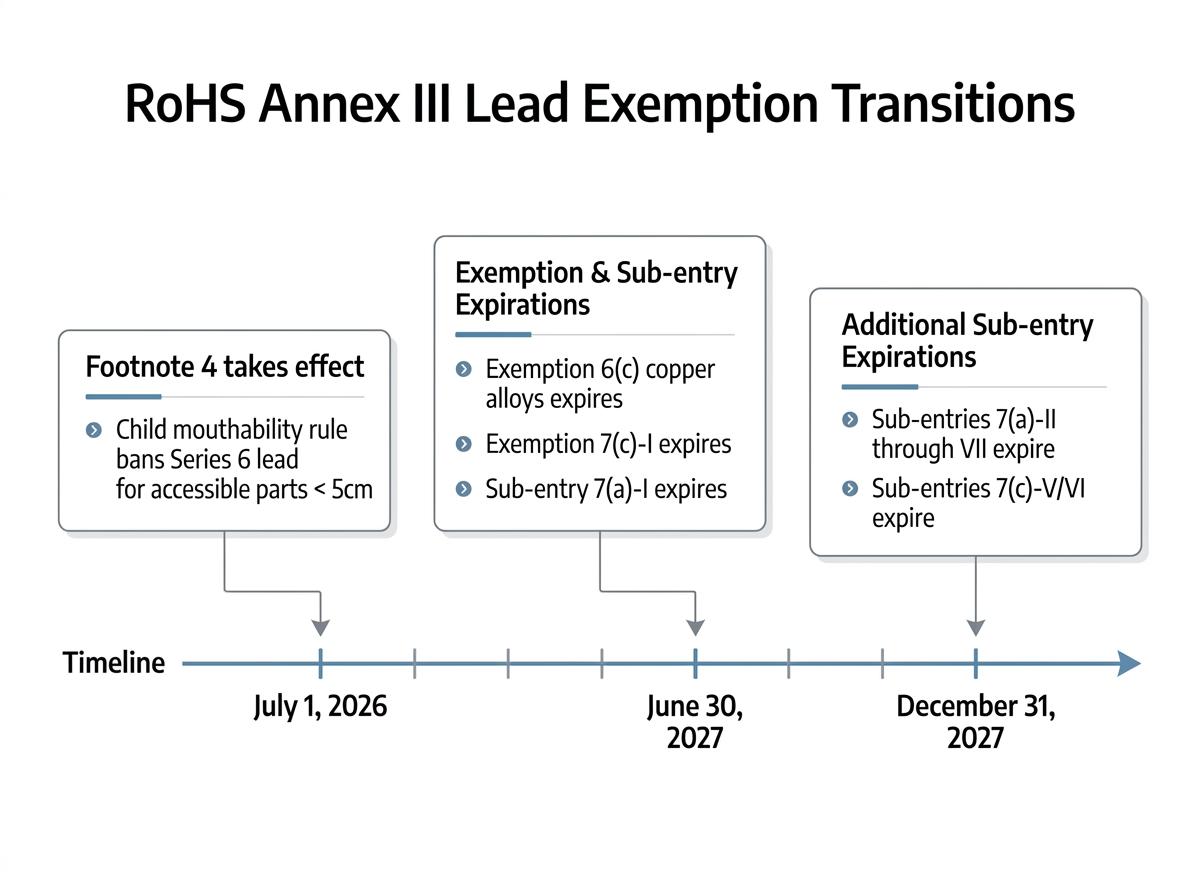
The Lead Exemption Restructuring (Series 6, 7a, and 7c)
| Exemption Code | Regulated Scope | Mandatory Expiration |
|---|---|---|
| 6(c) | Copper alloys containing up to 4% lead by weight | June 30, 2027 |
| 7(a) | Lead in high-melting-temperature type solders | Split into sub-entries: 7(a)-I: June 30, 2027 7(a)-II–VII: Dec 31, 2027 |
| 7(c)-I | Electrical and electronic components containing lead in glass or ceramic (e.g., MLCCs, piezoelectrics) | June 30, 2027 (Narrow sub-entries 7(c)-V / VI: Dec 31, 2027) |
- Exemption 6(c) (Copper Alloys): Extensively used in machined brass connector pins, RF shells, and terminal blocks. Components relying on standard leaded brass alloys (such as UNS C36000 / CuZn39Pb3 with ~3% Pb) face mandatory phaseouts by June 30, 2027, requiring migration to low-lead or lead-free silicon-brass or tellurium-copper alloys.
- Exemption 7(a) (High-Temp Solders): Split into specific sub-allocations (7(a)-I through 7(a)-VII). Standard power semiconductor internal die-attach solders and power module interconnections will lose broad coverage between June 30, 2027 and December 31, 2027, accelerating the transition to transient liquid phase sintering (TLPS) and silver/copper sintering pastes.
- Exemption 7(c)-I (Piezoelectrics, Resistors, Glass/Ceramics): Expiring June 30, 2027, forcing passive component manufacturers to segregate their product lines into narrower categories under 7(c)-V and 7(c)-VI or qualify pure lead-free thick-film resistor arrays.
The Footnote 4 Mouthability Rule (Effective July 1, 2026)
Starting July 1, 2026, Delegated Directives enforce Footnote 4 for Annex III entries 6(a), 6(b), and 6(c).
Critical Procurement Rule: Under Footnote 4, manufacturers cannot claim lead exemptions 6(a), 6(b), or 6(c) for consumer electrical equipment if any part containing lead is smaller than 5 cm or has a detachable section under 5 cm that can be placed in a child's mouth, unless the manufacturer proves via laboratory extraction testing that the lead release rate does not exceed 0.05 µg/cm²/hour.
Hardware categories such as wearable audio, remote controls, handheld IoT sensors, and smart toys must transition to lead-free brass/aluminum hardware immediately to prevent market lockouts in mid-2026.
Procurement Due Diligence, Data Standards, and Broker Risk Management
Procuring compliant parts requires transitioning away from generic, unverified compliance certificates toward structured, machine-readable Full Material Disclosures (FMD).
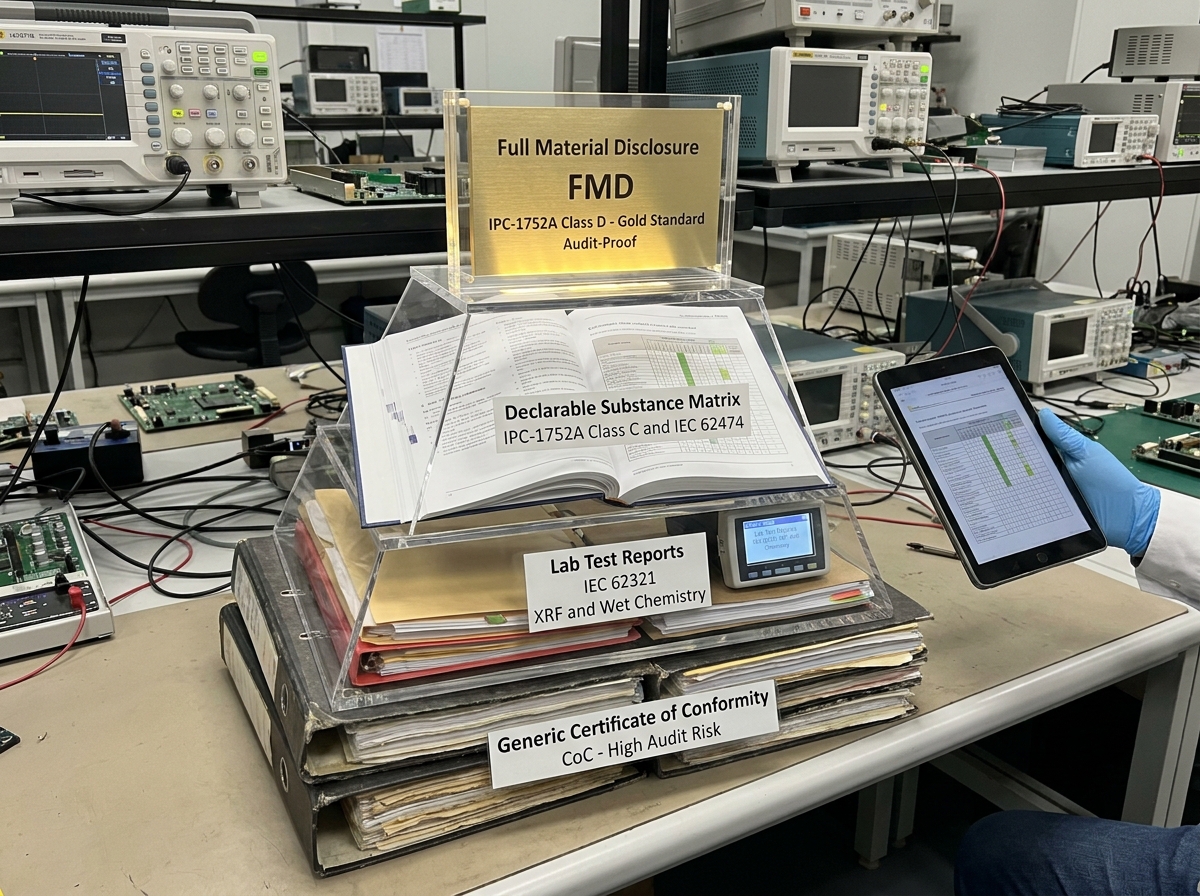
Full Material Disclosure (FMD) vs. Generic Certificates of Compliance (CoC)
A common point of supply chain failure is the acceptance of one-page PDF certificates stating that a component is "RoHS and REACH Compliant."
| Data Format | Standards Base | Audit Defensibility | Action on SVHC List Expansion |
|---|---|---|---|
| Class A / CoC | Generic Letter | Low | Invalidated (Requires manual re-request) |
| Class C | IPC-1752A[5] | Moderate | Re-evaluation required per substance |
| Class D (FMD) | IPC-1752A / XML | High (Authoritative) | Automatic re-screening via PLM database |
- Generic CoCs (IPC-1752A Class A): Only state compliance with a general list at a single point in time. When ECHA updates the SVHC list, every Class A declaration is rendered legally obsolete, requiring procurement to re-contact thousands of suppliers.
- Full Material Disclosures (IPC-1752A Class D / IEC 62474 DSL): Provide complete, 100% breakdown of every homogeneous material, its total mass, and all constituent CAS registry numbers down to 1 ppm resolution. When new SVHCs (such as n-hexane or bisphenol AF) are added, PLM compliance software can automatically screen existing FMD files across the entire active BOM in seconds.
Technical File Construction Under EN IEC 63000:2018
To legally apply the CE mark under RoHS Directive 2011/65/EU, OEMs must compile an official Technical Documentation file. Under European Commission Decision (EU) 2020/659, EN IEC 63000:2018[6] formally superseded EN 50581:2012 as the sole harmonized standard conferring a presumption of conformity.
Under EN IEC 63000:2018, compliance teams must:
- Classify components by technical complexity and supplier trustworthiness.
- Collect supplier declarations (IPC-1752A/IEC 62474), contractual agreements, or analytical test reports conforming to IEC 62321 (the international standard for XRF screening and wet chemical analysis).
- Maintain the technical file for 10 years after the last EEE unit is placed on the market. Technical files that still reference the withdrawn EN 50581:2012 standard fail EU market surveillance inspections.
Mitigating Independent Broker and Grey Market Risks
Procuring components through secondary distribution, independent stocking brokers, or unauthorized excess channels introduces severe compliance risks. Obsolete lead-finish semiconductors (e.g., SnPb leadframes) can be re-marked, packaged in counterfeit tape-and-reel, and shipped with fabricated "RoHS Compliant" CoC letters.
To prevent regulatory actions under the EU General Product Safety Regulation (GPSR) and national market surveillance laws, procurement teams sourcing outside authorized distribution must enforce strict quality controls:
- Mandatory X-Ray Fluorescence (XRF) Screening: Screen all incoming terminal platings and internal leadframes per IEC 62321-3-1 to confirm the absence of Pb, Hg, Cd, and total Cr/Br.
- Standardized Counterfeit Testing: Mandate compliance with AS6081 or IDEA-STD-1010-B testing regimens, including decapsulation and energy-dispersive X-ray spectroscopy (EDS) before releasing broker stock to manufacturing.
Procurement Verification Workflow
- Gate 1: Sourcing Intake
- Require IPC-1752A Class D (FMD) or IEC 62474 XML data from supplier.
- Reject generic single-page "RoHS/REACH Compliant" PDF letters.
- Gate 2: Exemption Cliff Screening
- Flag any part relying on RoHS exemptions 6(c), 7(a), or 7(c)-I.
- Require manufacturer transition roadmaps for sunset dates past June 30, 2027.
- Check consumer equipment under 5 cm against July 1, 2026 Footnote 4 lead limits.
- Gate 3: REACH & SCIP Evaluation
- Screen FMD data against the updated 253 SVHC Candidate List.
- If SVHC > 0.1% w/w in any constituent article:
- Acquire ECHA SCIP Dossier ID from supplier.
- Issue REACH Article 33 declaration to downstream B2B customers.
- Gate 4: Broker & Secondary Lot Audit
- Route unauthorized broker inventory to incoming laboratory inspection.
- Execute IEC 62321 XRF screening on all leads, terminations, and chassis alloys.
- Cross-check manufacturer lot codes against genuine PCN records.
- Gate 5: Technical File Integration
- Archive material disclosures and test reports into the EN IEC 63000:2018 technical file.
- Generate automated alerts for biannual ECHA SVHC Candidate updates.
Strategic Summary and Action Plan
Ensuring compliance across electronic components requires recognizing that RoHS and REACH serve different legal purposes. RoHS prohibits 10 substances at the micro-level of homogeneous materials, while REACH mandates transparent lifecycle tracking of 253 SVHCs across discrete constituent articles.
| Status | Procurement Action Item |
|---|---|
| [ ] 1 | Screen BOMs against the 253 SVHC Candidate List (incorporating n-hexane and BPAF). |
| [ ] 2 | Audit component reliance on expiring RoHS Lead Exemptions 6(c), 7(a), and 7(c)-I. |
| [ ] 3 | Apply the Footnote 4 test for consumer hardware under 5 cm ahead of July 1, 2026. |
| [ ] 4 | Transition Approved Vendor Lists (AVL) to mandate IPC-1752A Class D FMD disclosures. |
| [ ] 5 | Re-baseline all CE-marked RoHS technical files to EN IEC 63000:2018. |
| [ ] 6 | Enforce mandatory IEC 62321 XRF screening on all non-franchised broker component lots. |
Frequently Asked Questions
Does a component with a RoHS Certificate of Compliance automatically meet REACH requirements?
No. RoHS covers only 10 restricted substances at the homogeneous material level, whereas the REACH Candidate List contains 253 SVHCs (as of February 2026) evaluated at the constituent article level under the "Once an Article, Always an Article" principle. A component can be completely free of the 10 RoHS substances but still contain a REACH SVHC (such as a photoinitiator, plasticizer, or siloxane) exceeding 0.1% w/w, triggering mandatory Article 33 and SCIP notifications.
What happens if an electronic component contains an SVHC above 0.1% w/w? Is it illegal to sell in the EU?
Presence of an SVHC above 0.1% w/w does not trigger an automatic sales ban. It legally requires the supplier to provide safe-use instructions to commercial customers (Article 33(1)), fulfill consumer disclosures within 45 days upon request (Article 33(2)), and submit a product dossier to the ECHA SCIP database. The substance is banned only if it is explicitly listed on REACH Annex XVII (Restrictions) or Annex XIV (Authorisation) past its sunset date.
How does China RoHS differ from EU RoHS for component procurement?
China RoHS (Management Methods for the Restriction of the Use of Hazardous Substances in Electrical and Electronic Products) requires compliance markings regardless of whether thresholds are exceeded. If a component exceeds the MCVs, it can still be sold in China, provided it carries an Environment-Friendly Use Period (EFUP) orange label indicating the number of years before the substances might leak, alongside a detailed hazardous substance table in the user manual. In contrast, EU RoHS bans non-compliant, non-exempt components outright.
What is the difference between a Certificate of Compliance (CoC) and a Full Material Disclosure (FMD)?
A CoC is a high-level letter signed by a supplier stating that a part meets specific regulatory thresholds at a fixed point in time. It contains no compositional data. An FMD (standardized via IPC-1752A Class D or IEC 62474) provides the exact chemical breakdown, mass, and CAS registry number for 100% of the materials within each homogeneous layer. FMDs allow automated, instant BOM re-screening whenever new substances are added to regulatory candidate lists.
Who bears legal liability if a non-compliant component is imported into the EU via a third-party EMS or drop-shipper?
The entity placing the product on the EU market (the "importer of record" or the designated EU Authorized Representative) bears direct legal liability. Under the EU General Product Safety Regulation (GPSR) and Market Surveillance Regulation (EU) 2019/1020, EU customs and market surveillance authorities can issue commercial import bans, order product recalls, and impose fines on the importing entity, regardless of whether the manufacturing error originated with an offshore contract manufacturer or broker.
How frequently does the ECHA update the REACH SVHC list, and how does this affect existing inventory?
ECHA typically updates the Candidate List twice a year (usually in January/February and June/July). Once a substance is officially added to the Candidate List, Article 33 communication and SCIP notification requirements apply immediately to all articles placed on the EU market from that date forward. There is no grandfathering period for existing stock; component databases must be re-evaluated against the latest additions immediately.
References
- Candidate List of substances of very high concern for Authorisation — European Chemicals Agency (ECHA)
- Restriction of Hazardous Substances in Electrical and Electronic Equipment (RoHS) — European Commission
- Judgment of the Court (Third Chamber) of 10 September 2015 – Case C-106/14 (FCD and FMB) — Court of Justice of the European Union
- SCIP Database - Substances of Concern in articles as such or in complex objects (Products) — European Chemicals Agency (ECHA)
- IPC-1752A: Materials Declaration Management Standard — IPC (Association Connecting Electronics Industries)
- EN IEC 63000:2018 - Technical documentation for the assessment of electrical and electronic products with respect to the restriction of hazardous substances — International Electrotechnical Commission (IEC)