
Power devices used in EV charging applications must meet specific requirements related to power losses and much more.
STMicroelectronics has recently introduced its third generation of STPOWER silicon carbide (SiC) MOSFETs, targeting advanced power applications (such as EV powertrains) and other applications where power density, energy efficiency, and reliability are relevant key factors.
The transition to electrical mobility and the gradual replacement of internal combustion engines are driving the race to make increasingly efficient electric vehicles (EVs). For these applications, power electronics plays an essential role, allowing for more efficient inverters, converters, powertrains, and on-board chargers. Power devices used in EVs, as well as in many industrial applications such as EV charging stations, industrial drives, power supply for datacenters, energy generation and storage, must meet specific requirements related to power losses, breakdown voltage, switching frequency, maximum operating temperature, and thermal conductivity.
Even though silicon-based power devices have been widely used in power electronics for years, they exhibit some important limitations, including low bandgap energy, limited switching frequency, and low thermal conductivity. Wide bandgap devices (WBG), such as silicon carbide provide larger bandgaps, higher breakdown voltages and better thermal management. As a result, WBGs are replacing silicon devices in high voltage, high switching frequency, and high-temperature applications.
ST 3rd Gen SiC MOSFET for the EV Market
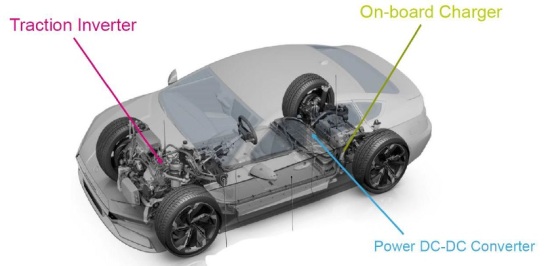
With the acceleration of the EV market, car makers are demanding higher voltage (such as 800V) drive systems to reduce charging time and overall EV weight, which in turn means longer driving ranges. ST 3rd generation STPOWER SiC MOSFETs have been specifically designed to meet the requirements of high-end automotive applications, including EV traction inverters, on-board chargers, and DC/DC converters (see Figure 1).
The new SiC-based devices are also suitable for industrial applications. In these, they can increase the efficiency of motor drives, renewable-energy converters and storage systems, as well as telecom and data-center power supplies.
ST’s latest STPOWER SiC MOSFETs set the bar for industry-leading benchmarks for the accepted figures of merit (FoMs) that express transistor efficiency, power density, and switching performance.
“This year, we started the production of our third-generation STPOWER SiC MOSFET, which offers a range of noticeable improvements with respect to the second generation products suiting ever-demanding requirements from our customers,” said Filippo Di Giovanni, Strategic Marketing Manager, Power Transistor Macro-Division at STMicroelectronics.
Among these improvements: the on-resistance (Ron) x die size FoM has been improved by 30%, while the Ron x gate charge (Qg) FoM has been improved on average by 50%.
The new devices will be available with nominal voltage ratings from 650V and 750V up to 1200V with 900V as intermediate step, providing designers with the flexibility required to address applications operating with ordinary AC-line voltages, up to those with high-voltage EV batteries and chargers. The 750V voltage variant provides extra voltage margin and has been introduced for the first time, in response to precise requests coming from customers.
“Historically, 750V voltage variant has been introduced for IGBTs. Since silicon carbide MOSFETs can replace IGBTs in more efficient applications, we are providing an extra voltage option which improves system performance without affecting the maximum voltage requirements,” said Di Giovanni.
Figure 2 shows, with a greater detail, how SiC MOSFETs can effectively replace IGBTs and Si MOSFETs in EV applications.
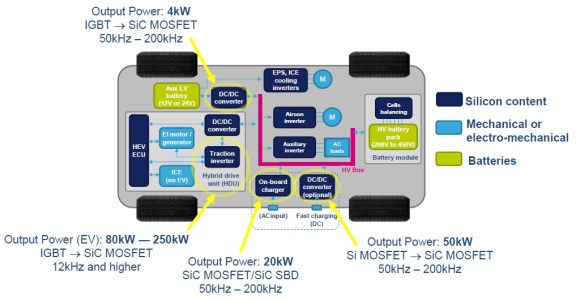
Compared to their silicon alternatives, SiC MOSFETs feature a higher voltage rating in relation to their die size, making these devices an excellent choice for EV applications and fast-charging EV infrastructures. In addition, they benefit from a very fast intrinsic diode that delivers the bi-directional properties needed for automotive on-board chargers (OBCs) used in Vehicle-to-everything (V2X) power flow allowing the transmission of electricity from an OBC battery to the infrastructure. In addition, silicon carbide supports higher switching frequencies, allowing for smaller passive components within the power systems, and more compact and lightweight electrical equipment in the vehicle.
“The achievements and improvements have been possible thanks to our proprietary planar technology that still lends itsels to further refinements. possible. In fact, we are still going down on our roadmap and anticipate being able to introduce a fourth planar iteration ,in a couple of years ” said Di Giovanni.
At ST, engineers have also started working on advanced simulations of new structures leveraging ST’s long-standing knowledge and expertise in power semiconductors.. They are in the beginning stages and are still busy improving the planar structure, which they consider among the best approaches for making silicon carbide MOSFETs.
ST will offer the third-generation devices in different forms, including bare dice, discrete power packages such as STPAK, H2PAK-7L, HiP247-4L, and HU3PAK and power modules of the ACEPACK family. The packages, too, offer innovative design features such as specially placed cooling tabs that simplify connection to base-plates and heat spreaders in EV applications. The options give designers choices that are further optimized for applications such as EV main traction inverters, on-board chargers (OBCs), DC/DC converters, e-climate compressors, and industrial applications such as solar inverters, energy storage systems, motor drives and power supplies.
Regarding the applications, Di Giovanni thinks that the largest market will continue to be in electric vehicles. In terms of volumes, he thinks the automotive sector will still drive the production capacity for silicon carbide even if the Company has already started serving the high-end industrial market. When ST started the production of its first 1200V SiC MOSFET in 2014, it was targeted primarily to the solar inverter market. Then, they took the courageous decision to use this brand new technology for the nascent EV market, allowing ST to become an undisputed market leader in this technology.
“After having tested and debugged this technology in the hostile and harsh environment of automotive applications, we can safely propose this technology to any other market, including the industrial market,” said Di Giovanni.
To meeting growing demand, ST is expanding the production and the manufacturing capacity of its silicon carbide MOSFETs. After starting a second 6” line in Singapore, ST has expanded the capacity of their main site in Catania (Italy), successfully reproducing the first 8” SiC prototypes, first by realising diodes.
“We plan to reach $1 billion mark in revenues on all silicon carbide products in 2024, which is one year earlier than we’d previously announced,” said Di Giovanni.