
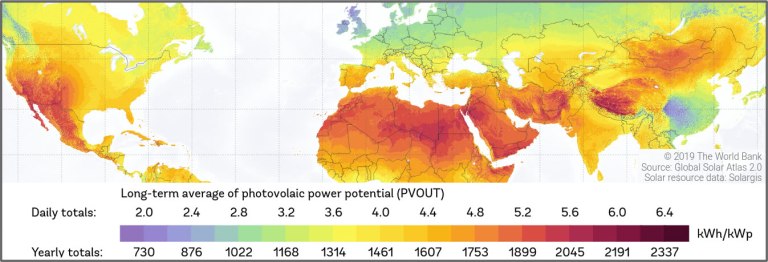
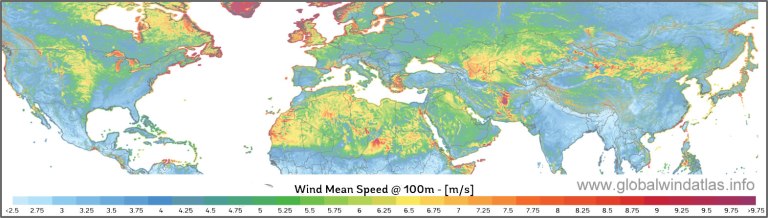
Regions conducive to solar farms and wind farms are often 500 to 2000km away from large cities, as shown in the below solar map and wind map. Also, solar and wind are “intermittent”, which means they vary in time, and in an uncontrollable manner. For both reasons, we would like to be able to transmit large amounts of electricity, long distances, and at low cost.
Super Grid
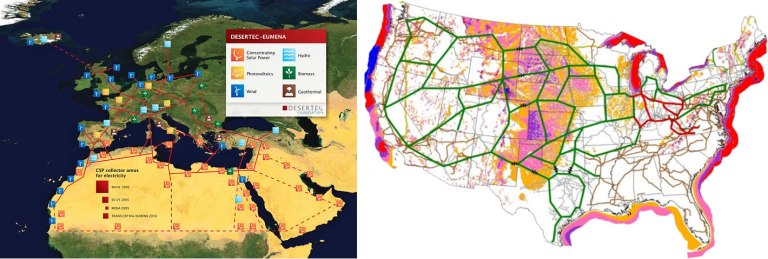
In theory, a new power transmission network could connect together many distant solar farms, wind farms, hydro-electric dams, nuclear power plants, and high population areas. If one region is not windy or sunny, then another region with excess capacity might be able to assist. This is commonly referred to as “Super Grid”, and multiple proposals have been written. For example, a US proposal moves wind power from the center of the country outward, as illustrated below-right. And a European proposal moves solar power from North Africa, and wind power from the Atlantic Ocean, as illustrated below-left.
China is currently the leader in moving large amounts of electricity over long distances, and has installed more ultra-high voltage power lines than any other nation (e.g. 8 GWe, ±800 kVDC or 1000 kVAC).
Super Grid Challenges
Super grid involves multiple challenges:
- Continent-sized weather patterns occasionally cause power to decrease from many solar farms and many wind farms. One remedy is to fill-in with power generation capacity that is idle while solar and wind is sufficient; however, maintaining this is costly. Another remedy is to rely heavily on concentrated solar plus molten salt storage plus carbon-based fuel, which delivers power 24 x 365; however, this is costly too.
- We still need green source plus transmission, to cost less than carbon options close to consumer; otherwise, communities will continue to burn cheap nearby coal and natural gas.
The above challenges are daunting; however, with significant cost reduction, engineers might be able to make super grid work.
Power transmission has been under cost-reduction pressure for 100 years. Therefore, it seems doubtful that decarbonization engineers can further reduce transmission costs beyond what the power industry is already doing; unless there are key components that are not being mass produced due to low volume, or specialized equipment is not being developed because it is too complex.
High Voltage AC vs. DC
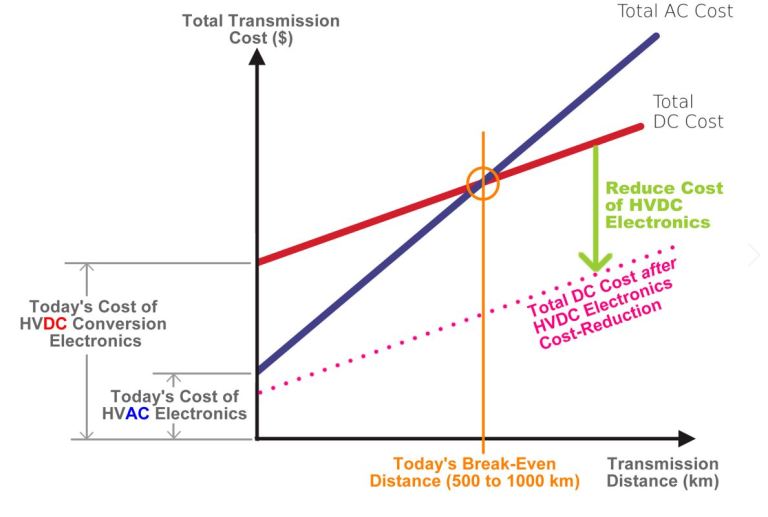
Power can be transmitted either in high voltage AC or DC form; each of which has their advantages and disadvantages. AC more easily supports multiple low cost taps along the line; whereas DC works better with different sinewaves at source and consumer, underground cables, and long distances (i.e. is not affected by line capacitance). One might advocate running a DC line 2000 km with conversion electronics at both ends; however, in many cases, power companies prefer AC transmission, with multiple sources and consumers along the route, who tap-in via relatively low cost transformers. If you want DC to surpass AC, you need to reduce the cost of conversion electronics, and develop low cost taps, as illustrated below.
Moving Unusually Large Amounts of Power
The two lower-left photos show 8-cable bundles that are much larger than the typical 3-cable bundle, shown lower-right. To move large power, one might place ~1.6 million Volts across two large bundles, while the voltage across cables within each bundle is ~0 Volts. Workers shown below were not harmed during unpowered construction.

Towers that support heavy bundles need to be strong, and towers that support very high voltages need to be tall; therefore towers that move large amounts of power are likely to be tall, strong, large, and heavy.
If one places eight 5cm (2 inch) diameter 1500 Amp aluminum cables into one bundle, with 1,600kVDC (±800kVDC) across two bundles, then one can move 19.2 GWe over a 2000km distance, with 5.2% power loss, for example. If towers are spaced every 0.8km, they would each support 70 metric tons of weight from cables, and total cost of raw aluminum for cables would be $0.46 billion dollars, at $2.62/kg, for example. If each tower weighs 200 metric tons, and steel cost $500/ton, then each tower would require $100K of raw steel. If non-steel tower costs are $400K per tower, and one needs 2,500 towers per line, then total tower cost would be $1.25B per line. If other costs are $2.5B per line, then total cost per transmission line would be $4.2B, which works out to $0.21/Watt, which is reasonable ($4.2B / 19 GWe). These numbers assume significant cost-reduction measures are implemented, as discussed in this article.
Global Super Grid
We will now run some numbers to get a sense of how much a global super grid might cost. As noted in 10 Things You Need To Know to Solve the Climate Change Problem, the world consumes approximately 56,000 TWh/yr of energy, and this corresponds to 16,000 GWe if used 40% of the time, on average ((56,000 * 1e12 / (24hrs * 365days)) / (1e9 * 40%)). If one moved this energy in large 19 GWe transmission lines, one would need 830 lines, for example (16,000 GWe / 19 GWe). If built over 20 years worldwide, one would build 41 new lines each year (832 lines / 20 years); which works out to 7/yr for the US ($28B/yr), 10/yr for China ($42B/yr) and 6/yr for Europe ($24B/yr), for example.
Shown below are calculations for a global super grid that moves today’s energy consumption through large 19 GWe 2000 km transmission lines. To see this more clearly, click on the picture. If you want to plug in your own numbers, download our spreadsheet and view “Global Super Grid” in worksheet “Plan”.
If one is not comfortable with distant power and a big grid, then consider cost-reduced nuclear power ≤ 200km from consumer, as described in How the US Gov’t can Solve the Climate Change Problem for $100B.

Develop Automated Tower Assembly System
To reduce transmission costs, engineers can explore automating the transportation and construction of large towers via specialized equipment under computer control. If new machines perform assembly on site, we can make towers taller, wider, more complex, and less costly. If we go taller, we can do more with the same amount of land, and work with higher voltages.
Engineers can look at modular tower systems that supports transmitting 1, 2, 4, 8, 16, 32, 64, and 128 GWe. Larger capacities would probably require adjacent multiple towers. Normally, 8 GWe is considered very large; however, decarbonizing the world requires working with larger sizes. For example, one might use 53 lines of 19 GWe each to move 1000 GWe out of a large desert (53 x 19, 100% CP, solar plus storage).
To get a sense of how transmission towers are assembled, one can view the following videos: (a) vertical assembly via crane, (b) horizontal assembly with 90 degree pivot into vertical position, (c) largest tower in the world at waterway crossing, and (d) cable installation.
Robots Build Super Grid While You Sleep
A reasonable next step would be for a foundation or gov’t to fund 10 different teams with $2M each, over 2 years, to develop rough designs and simple prototypes for a new generation of tower, with automated assembly.
Here is an example concept, to give one an idea of what a team might do:
- Bulldozer and Roller under computer control create flat work surface for tower assembly.
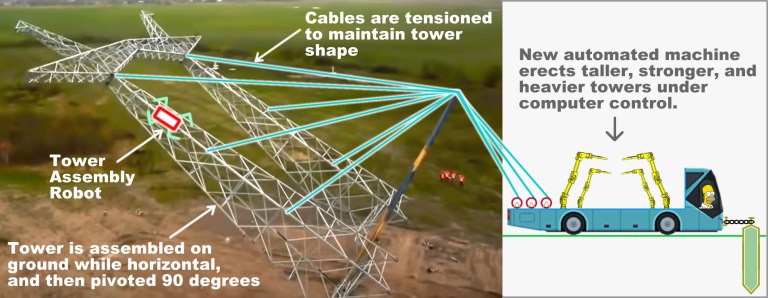
- Specialized machine under computer control assembles tower while horizontal on land via industrial robots, and applies tension to multiple cables to pivot tower 90 degrees into vertical position, as illustrated above. Multiple wenches maintain tower shape during pivot.
- A supply vehicle that resembles a flatbed truck, with tower components, positions itself near assembly vehicle, and is coordinated via computers.
- A vehicle with auger, not shown, under computer control, drills holes for tower foundation. Also, it drills hole(s) for wench anchor, inserts pin into hole, and chains pin to wench. Pin is shown lower-right in above illustration.
- Optionally, a jig attaches to tower, to support taller and larger towers, and cable(s) pull on jig to pivot 90 degrees.
- Jig and pivot fulcrum are both longer than trucks; therefore, a system is designed to transport fully assembled equipment, via two vehicles, one at each end, under computer control. If towers are spaced every 1km, and one installs 1000 towers, then long equipment would be transported approximately 1000 times, for example.
- Small tower robot with mechanical arms, shown above, traverses rails, and aids in assembly and maintenance, in a manner similar to that done by a worker. Tower rails mechanically interface to robot.
If the world is going to spend hundreds of billions of dollars on transmission towers, it seems reasonable to spend $20M exploring automated assembly.
Develop Next Generation DC Conversion Electronics
High voltage DC power transmission requires expensive conversion electronics, and these are manufactured in relatively low volumes. Subsequently, decarbonization engineers can explore buying the design of HVDC conversion electronics (or designing from scratch), building a factory that mass produces, giving all technology away for free to commoditize, and reducing price worldwide. One would need to justify commoditization costs by saving more when manufacturing. A standardized design could support transmitting and receiving power at each end, in addition to tapping-in along the path. Also, it would probably be modular, to support different voltages and currents.
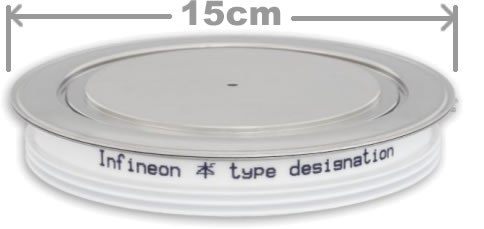
The Infineon #T2251N70 thyristor (7.5kV, 2300Amp, $3000), pictured below, is an example of a component used in high voltage DC conversion. In a typical 2 GWe system, one might utilize 4,000 of these at each end of the transmission line, for a total thyristor component cost of $24M (2 ends x 4K x $3K). Engineers can explore buying the design of a high voltage thyristor component, making it public to commoditize, and having it mass produced in large quantities, by a foundry, to reduce cost.
Pictured below is a high voltage AC/DC conversion system that utilizes thousands of thyristors.
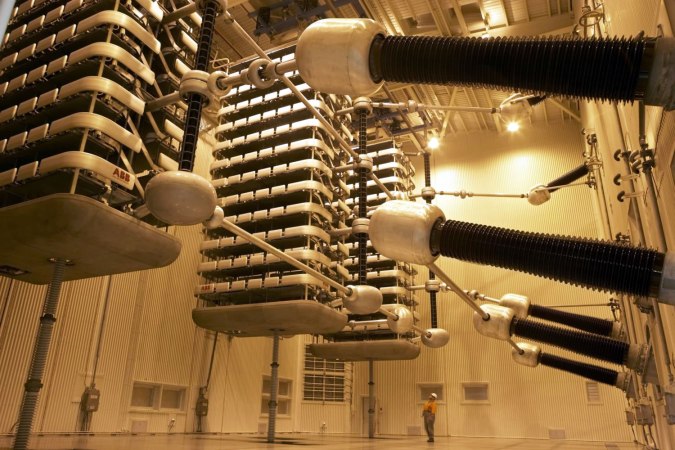
To reduce costs further, engineers can explore manufacturing large transformers and capacitors, not shown in above picture, via robotic assembly, in a factory. If key components are mass produced, standardized, and commoditized; one could potentially see moderate cost-reduction.
Also, engineers can explore developing a battery powered robot that is mounted on the end of an insulated articulating arm, capable of touching high voltages while operating at full power (due to insulated arm and self-powered robot at tip). This could inspect components with both infrared and optical cameras, to look for excess heat and other problems, possibly before failure. And, it could add jumpers to divert current away from suspect components, and replace components, while at full power.
Down-time is costly when moving large amounts of power; therefore, the cost of automated inspection, maintenance and repair, might be justified.
Transmission Challenges
If we drop the cost of HVDC conversion electronics and towers, we still need to contend with multiple challenges:
- Cost of land, cable, installation, and maintenance.
- Longer cables are more susceptible to failure.
- Green energy generation plus transmission must be less costly than carbon options close to user.
- Nevada gets most of its electricity from natural gas, which tells us transmission is not the problem with solar farms. We need to make these more economically feasible in nearby desert communities, before we can expect to make them popular in distant cities.
To mitigate challenges, we can consider:
- Government passes laws that make it easier to demand right of way for power wires, to reduce land costs.
- Work with higher voltages since they can move more power for the same land, tower and cable costs. Currently -800VDC and 1000VAC are considered feasible; however, a new generation of tower and conversion electronics might help support higher voltages.
Conclusion
A super grid would constitute a radical departure from our current system, which typically relies on energy sources ≤ 200 km from consumer. Making super grid work economically would be a great challenge; however, a good first step is to develop a new generation of tower, and high voltage DC conversion system. These two components, and cable, constitute the entire system.
Governments often look for proposals to review, and decide yes or no. However, one might need to first spend millions of dollars on engineering before they can produce quality proposals. Initial engineering includes exploring multiple options, doing rough designs, assessing feasibility, building simple prototypes, and modeling costs. Unfortunately, gov’t is often slow to spend this kind of money before committing to a project, which is a costly mistake.
Alternatively, a group of engineers responsible for solving the entire climate change problem would see this differently. They would recognize transmission as an important part of decarbonization; they would understand engineering takes time; and they would have engineers explore new generations of towers and conversion electronics, along with other cost-reduction measures.