
Legacy cellular generations are all about mobile user connectivity – voice connectivity for 2G and data connectivity for 3G and 4G. 5G disrupts this trend by connecting users to a new world of mobile and nomad smart connected things creating new user experiences fueled by unprecedented mobile network capacity with on-demand data throughputs at record low latencies.
Rolled out in parallel to 5G, Wi-Fi 6(E) is one of the most popular choices for high capacity multi-user indoor networks – home, enterprise and public venues such as convention centers and others. It is easy to maintain and scale up and, more importantly, easy to use. Wi-Fi 6(E) is backwards compatible which means that previous Wi-Fi generations installed Access Points (AP) can still be leveraged.
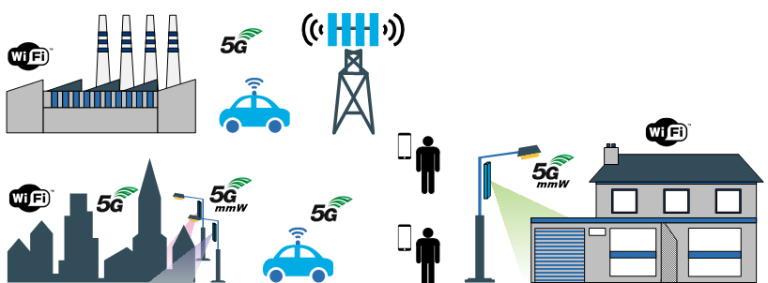
5G and Wi-Fi 6(E) have been conceived with complementary use scenarios in mind and to work together for a complete integration of mobile users and all smart mobile, nomad and fixed connected things surrounding them. Figure 1 provides a representation of the 5G Wi-Fi ecosystem. For users, this will translate in the near-term availability of long-awaited applications like assisted driving cars, factory increased automation and many other.
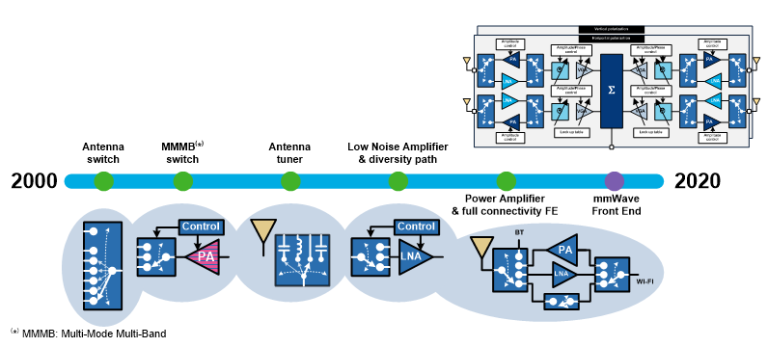
It all started nearly two decades ago when RF-SOI substrates caught the semiconductor community’s attention with their capacity to deliver the required performance to enable true mobile smartphones – a handheld computer with ubiquitous connectivity. Since then, as shown in Figure 2, RF CMOS technologies and RF-SOI substrates have been evolving together to make possible robust and reliable modern advanced cellular and Wi-Fi RF Front End (RFFE) [1].
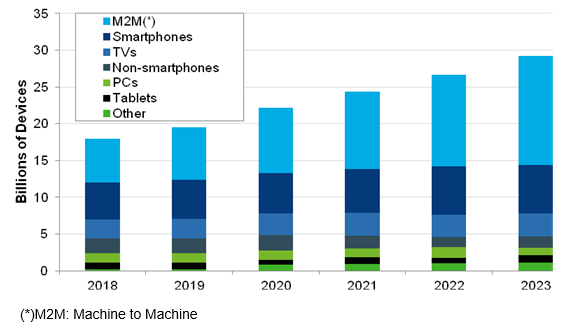
Today’s global quasi-endless CMOS production capacity and the demonstrated large scale manufacturability of RF-SOI substrates have fostered the development of affordable smartphones for mass markets. Ubiquitous connectivity is now expanding to smart things with over 20 billion devices set to connect wirelessly to the Internet in 2020 in factories, office buildings, public infrastructure and others as shown in Figure 3 [2]. RF-SOI, as one of the technologies of choice, will continue to play an essential role to ensure cost-efficient, reliable and robust connectivity.
In order to set common world targets, the International Telecommunication Union (ITU) published a framework and overall objectives of the future development of the International Mobile Telecommunications (IMT) for 2020 and beyond [3] identifying three axes of development for IMT which have been adopted by the 3rd Generation Partnership Project (3GPP) to provide specifications for 5G services and applications [4]. The massive Machine Type of Communications (mMTC) axis targets to enable the connection of a very large number of devices per area. The enhanced Mobile Broad-Band (eMBB) axis points to support high speed, large capacity broadband data access. Finally, the ultra Reliable Low Latency Communications (uRLLC) axis addresses real-time robust and reliable connection during a given period of time.
Based on the main characteristics that devices should possess in each of the three categories, Soitec has extended its RFeSI product family [5], [6] with the introduction of RFeSI100 which provides unparalleled linearity for all use cases comprised in eMBB and uRLLC. mMTC could also benefit from RFeSI100 when the final application requires it.
Introduced in parallel, an optional feature RFeSI_T (“T” standing for temperature), allows all substrates in the RFeSI family (RFeSI80, RFeSI90 and RFeSI100) to benefit from very low linearity drift over extended temperature ranges for increased robustness in mission critical applications.
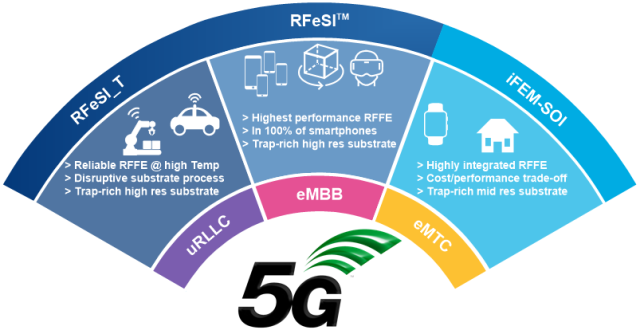
Finally, aware of the pressure on Total Cost of Ownership (TCO) in mMTC, Soitec introduces a new iFEM-SOI substrate with a simplified manufacturing process to provide the right performance at optimized RFFE TCO. Figure 4 links 5G’s three development axes with Soitec’s substrates families and shows how thanks to their unique characteristics, such substrates represent some of the best options on which to build the respective RFFEs.
All these innovations are discussed in further detail in section 3 dedicated to RF-SOI substrates innovations for 5G.
This whitepaper is the first part of a series of two and will introduce some of 5G’s most innovative new features – compared to former cellular standards – and how they are driving an evolution of the mobile, nomad and fixed equipments’ RFFEs. It will then provide guidance on how Soitec’s RF-SOI substrates can help address the challenges and the constant innovation required to best support 5G deployment.