
Close to 150 years ago, Jules Verne set out a prescient vision that has inspired governments and entrepreneurs. But despite much hope and hype, hydrogen has always been considered as an anecdotal source of energy.
Close to 150 years ago, Jules Verne set out a prescient vision that has inspired governments and entrepreneurs. But despite much hope and hype, hydrogen has always been considered as an anecdotal source of energy and mainly used as feedstock for industrial and agricultural applications (e.g., fertilizer, fuel refining, plastic, metallurgy).
Like Jules Verne, we have all dreamt about “green hydrogen,” but the reality today is that in practice, it’s more a case of “brown and grey” rather than “blue and green” hydrogen. Hydrogen production is almost entirely fueled from fossil sources, and more than 70% of global production comes from steam reformation of natural gas. In this process, the methane reacts with steam, causing a reaction by which hydrogen and carbon dioxide are produced. As a consequence, the worldwide production of hydrogen is responsible for CO2 emissions of about 830 million tons per year, equivalent to the CO2 emissions of the United Kingdom and Indonesia combined.
That has been the situation for more than a century, but things are changing and Europe is engaged in a process to develop a climate-neutral economy in which green and blue hydrogen plays a major part.
Powering a climate-neutral economy
Part of the so-called “European Green Deal,” the EU has laid out a strategy that will contribute to transform the European Union into a fair and prosperous society in which there will be no net emission of greenhouse gases by 2050.
In line with the Paris Agreement and the United Nations 2030 Agenda for sustainable development, on July 8, 2020, the European Commission issued a document (COM/2020/299 final) describing the strategy for a clean energy system integration.
Taking into consideration all aspects of the various energy sectors, the strategy aims to reduce and eliminate CO2 emissions but also to diversify Europe’s sources of energy, making better, more efficient use of the energy produced within the EU.
This will require a fundamental transformation of the European energy system, which today comprises fossil fuel (solid, petroleum, gas) (72.4%), nuclear energy (12.9%), renewable (14.6%), and other (0.1%).
The overall strategy to power a climate-neutral economy includes all aspects of the energy-production system across multiple energy carriers, infrastructures, and consumption sectors, as well as the analysis of what is needed to achieve climate neutrality by 2050.
In this strategy, hydrogen has been considered an important part of the ecosystem and addressed in a specific sub-project: “A hydrogen strategy for a climate-neutral Europe (COM/2020/301 final).” Making the production of hydrogen cleaner and optimizing its utilization for transportation, energy storage, and many other areas have been addressed in this sub-project.
The European hydrogen strategy
Clearly too broad a subject to cover all aspects that it involves, in summary, the EU hydrogen strategy is aiming to use renewable hydrogen in industrial processes and heavy-duty road and rail transport, in synthetic fuel production from renewable electricity in aviation and maritime transport, or in biomass in those sectors where it has biggest added value.
Hydrogen ‘in colors’
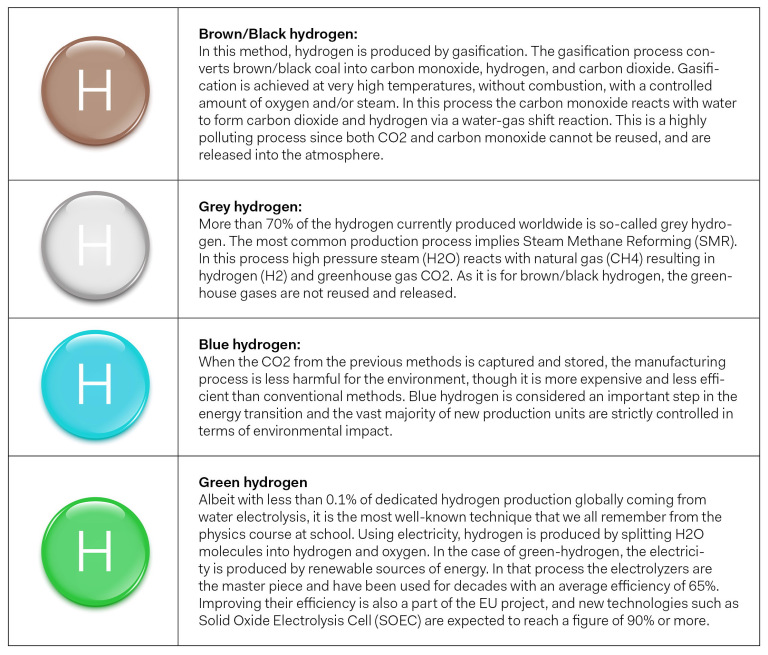
To begin, hydrogen is not a raw fuel, and its production requires a certain chemical reaction that can result in significant CO2 emissions. It is important to differentiate the different methods of production and their environmental impact. To make it easier to understand that relationship, a de facto definition has been used within the industry, and four main categories have been defined (Figure 1). The long-term goal is to use only green hydrogen, though in the short and midterm, blue hydrogen is needed to support the deployment of hydrogen in Europe, implying efficient carbon capture and storage technology to reduce greenhouse emissions.
Making green hydrogen a reality
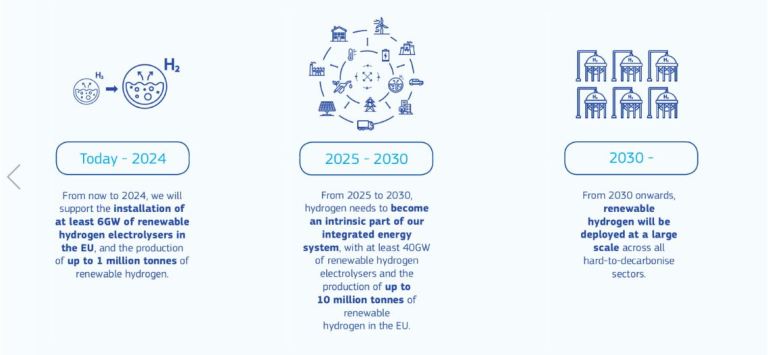
As shown in Figure 2, the EU strategy to develop renewable hydrogen is based on three phases with reasonable targets and goals. By 2050, the renewable hydrogen technologies are expected to have reached maturity and deployed on a large scale to contribute to decarbonize sectors in which other alternatives are not feasible or of prohibitive cost. To reach this goal and to produce renewable hydrogen in volume will require a great amount of investment and strong cooperation between the different sectors, from research to end user.
While the strategy was released in 2020, the research and initiative started much earlier, and a number of projects have benefited from the €80 billion funding from the EU Research and Innovation program, Horizon 2020. From 2014 to 2020, under this program, an impressive number of projects have been conducted. More information can be found on the Horizon 2020 website, but we would like to share one example of a project contributing to make the steel and heavy industry cleaner.
Due to the massive use of coal, the iron and steel industry is responsible for about 4% of anthropogenic CO2 emissions in Europe and 9% worldwide. Replacing coal with hydrogen generated from renewable energy would make it possible to largely decarbonize this industry. The project H2FUTURE developed best practices to use the excess electricity from renewable sources to produce hydrogen from electrolysis. The hydrogen can be stored and used for fuel cells to deliver power when needed. The project has focused particularly on deploying a large-scale electrolysis system operated for steel manufacturing. One outcome from this project is the demonstration of the increasing power of electrolyzers, highlighting their suitability for energy-intensive heavy industries.
Pilot case
Engaged in a process to reduce its carbon footprint, Austrian steel manufacturer Voestalpine set a goal to reduce its CO2 emissions by 80%. A large part of this reduction required them to change their way of working when manufacturing steel. The company research team investigated the practicality of using a hybrid technology to bridge the gap between the existing coke-/coal-based blast furnace route and electric arc furnaces powered by green electricity partly generated using green hydrogen. It was obvious that hydrogen would make the deal and here started one of the European flagship projects for hydrogen.
Under Horizon 2020, after receiving EU agreement and a funding of €12 million, on Jan. 1, the H2FUTURE project began. As defined in the project, under the coordination of Verbund (energy supplier), Voestalpine (steel manufacturer), and Siemens (proton exchange membrane, or PEM, electrolyzer manufacturer), the goal was to install and demonstrate the ability of a 6-MW electrolysis power system to deliver hydrogen to the Voestalpine Linz plant. The project also included competences from Austrian Power Grid and research partners K1-MET and Energieonderzoek Centrum Nederland (ECN).
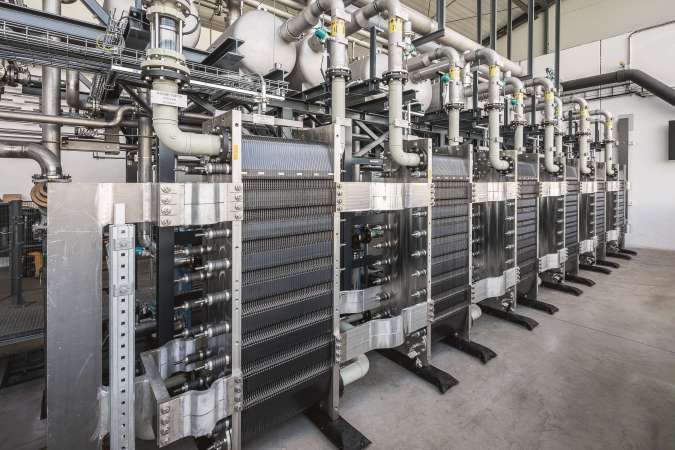
Connecting such an installation to the grid presented many challenges. One important step has been to test PEM electrolysis technology on an industrial scale (6 MW) and to simulate rapid load changes in electricity generated from renewable energy sources and from electric arc furnace steelmaking (grid balancing). This has been successfully completed, and in November 2019, the kickoff of the largest green hydrogen facility took place (Figure 3).
With a capacity of 6 MW and a production of 1,200 m3 of green hydrogen per hour, H2FUTURE has proven the ability of that technology, contributing to the European goal of becoming climate-neutral by 2050. H2FUTURE is one of many projects initiated under Horizon 2020, setting the foundations for hydrogen to become an intrinsic part of the European Union’s integrated energy system. The EU hydrogen strategy Phase ONE is just the beginning of a long journey of technical innovations to make Jules Verne’s vision a reality.