
The new digital Zero Voltage Switching (ZVS) chipset from Dialog Semiconductors allows developing high-power density power supplies of over 100 W in a small size.
The new digital Zero Voltage Switching (ZVS) chipset from Dialog Semiconductors allows developing high-power density power supplies of over 100 W in a small size.
Thermal constraints on system efficiency create a limit in AC/DC converters, but proprietary ZVS technology reduces the size and offers low BOM cost, thus allowing having smaller power supplies.
Power Electronics News has interviewed Tony Lai, Director of Marketing AC/DC Products, Dialog Semiconductor. He explained that Dialog’s ZVS, or zero voltage switching, technology is used to significantly reduce switching losses of the power supply and he added: “This patented approach intelligently adapts the ZVS control to the overall circuit conditions. This enables high efficiency over the load and input voltage ranges, especially when combined with Dialog’s adaptive multi-mode control and helps designers create 30% to 50% smaller form factor, high power density PSUs,” commented Lai.
ZVS for Power Supply
Dialog’s ZVS RapidChargeTM solution comprises the iW9801 primary-side controller and iW709 secondary-side USB PD protocol IC. This chip set offers a complete, simple-to-use high power density AC/DC charging solution, efficiencies up to 94% and advanced protection features to enable high power charging with safe, cool operation in a small physical charger size. iW709 integrates a USB power delivery (USB PD) 3.0 interface controller with a synchronous rectifier (SR) controller and USB Type-C disconnect NFET driver into one device.
“The iW9801, with its innovative ZVS technology employs higher switching frequencies up to 200kHz, so PSU designers can use a much smaller transformer and tinier passive components, reducing charger size, weight and cost. Although higher switching frequency in conventional designs can cause higher primary FET switching losses, our ZVS technology operates under multi-mode control (MMC) with main switch ZVS turn-on at high line voltage to achieve low switching loss and low EMI,” said Lai.
A secondary-side digital compensation loop in the iW709 secondary-side IC ensures stability, eliminating the need for extra compensation components, and an integrated synchronous rectifier controller on the secondary-side IC further reduces the overall component count and cost. This reduces the form factor of the PSU device.
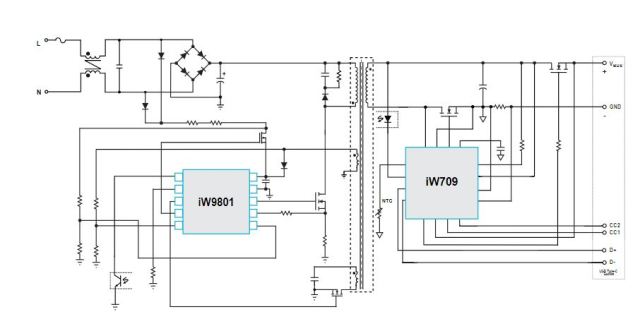
“The secondary-side IC in our ZVS chipset uses a built-in digital compensation loop for output voltage and current regulation to ensure stability,” commented Lai. “The output voltage and current are sampled by a 10-bit ADC and sent to the digital compensator to manage. This eliminates the need for external compensation resistors and capacitors, simplifying the PSU design, shortening the development cycle, and helping to further reduce the BOM size and cost.”
Dialog’s adaptive Multi-Mode Control (MMC) uses PWM, PFM and burst mode control to dynamically change the MOSFET switching frequency based on input voltage and current limit detect voltage, enabling high overall efficiency up to 94% and above 88% over the typical operating range.
Tony Lai highlighted that Dialog’s ZVS technology provides high efficiency at high AC input levels, for example 230Vac, which is difficult to achieve using conventional flyback PSUs. “At no load, the power consumption of our ZVS solutions can be less than 20mW, resulting in a very eco-friendly solution.”
One of the key challenges in PSU design is audible noise that can be produced in the PSU, especially at light loads. “In addition to its efficiency benefits, the ZVS technology prevents audible noise at lighter loads by keeping the switching frequency above the audible frequency band (10Hz to 20kHz),” said Lai.
The chipset offers robust protection for over-voltage (OVP), over-current (OCP), user-configurable over-temperature, shoot-through, short VSENSE/ISENSE brown-in/brown-out, short-out and extra OCP and OVP on the primary side. Dialog’s ZVS chipset supports most fast-charging protocols, including USB PD 3.0 with Programmable Power Supply (PPS) and other third-party proprietary protocols.