
Solar farms could be the solution to replacing the oil, natural gas and coal used to produce energy.
This article discusses how one might replace all of the world’s oil, natural gas and coal with large solar farms.
Solar has Problems
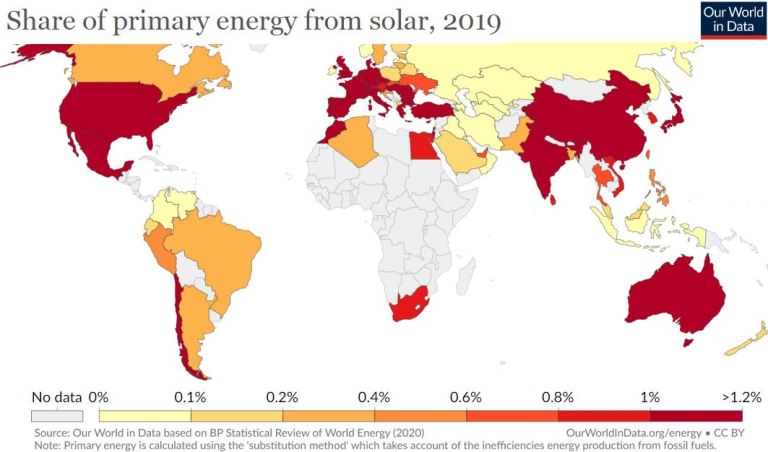
News reports on solar farms show pictures of solar panels with an uplifting theme. However, they ignore what is next to the farm, which is often empty space. And this is more interesting, since it tells us these are not conducive to making money, since if they were, someone would be building more. The reader might be skeptical that solar has problems, after many years of positive news. So let’s look at the numbers. The illustration below shows percent of total energy derived from solar, for each country. Notice the small numbers on the scale at the bottom of the illustration.
The illustration below shows US solar installations, and sun illumination. The US gets 2.3% of its electricity from solar farms (96 / 4126 TWh/yr); and it gets 1.0% of its total energy from solar farms (96 / 9205 TWh/yr).

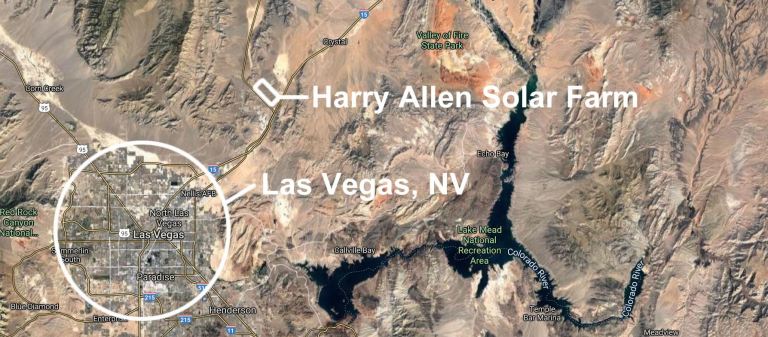
If we look at a satellite view of the region close to Las Vegas, as shown below, we see only a small fraction of land used for solar farms. Nevada has plenty of unused sunny land, and solar panels are cheap; however, this state gets most of its electricity from natural gas. This tells us solar incurs obstacles, before tackling the transmission challenge for faraway consumers.
The Reality of Solar
Solar farms are not more popular due to several obstacles:
- Intermittency: PV solar farms turn off when the sun stops shining, which means one needs another power station to turn on, when solar turns off. And having two facilities is costly.
- Underutilization of co-located processes: When using PV solar to power an industrial process, such as hydrogen production, the processing equipment is idle ~75% of the time, which is costly.
- Energy storage with PV solar is costly: As a remedy to the above problems, one might look at storing energy and providing power 24 hours-per-day. However, storage is costly when working with PV solar. Alternatively, storage is cheap when working with concentrated solar molten salt, since already-hot salt can be tanked at little additional cost. Yet concentrated solar is currently expensive.
- Transmission is costly: Typical green energy transportation methods are electricity in a wire, hydrogen gas or liquid ammonia in a pipe, and liquid ammonia in a tank on a train or a ship. And all of these are costly, relative to placing a carbon-based power station close to consumer.
US Green Energy Projections
The US Energy Information Administration (EIA) Outlook 2021 Report projects US electricity from solar farms and PV on buildings to increase from 125 TWh/yr (~3%) in 2020, to ~1000 TWh/yr (~20%) in 2050, as shown below. Solar is not expected to exceed 20% of total US electricity in 2050 due to a variety of limitations. However, this picture would change if engineers made PV solar plus concentrated solar cheaper than carbon-based fuels, and gov’t increased intervention in the solar industry.
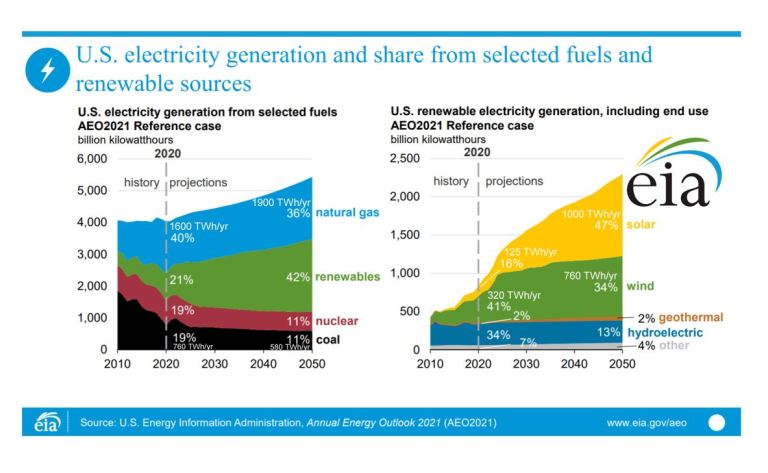
If one looks closely at the above graph, they might notice coal and natural gas are not decreasing. For this reason, EIA projects US CO2 emissions to remain constant over the next 30 years. For a discussion on why the US, and others, are failing, and what one might do about it, see A Plan to Get to Zero CO2 Emissions.
The Good News About Solar
A solar farm that covers 38% of Nevada could provide enough energy to satisfy total US energy demand; and replace all oil, natural gas, and coal. Also, China’s deserts are large enough to power all of China, and North African deserts are large enough to power all of Europe. In other words, land is not the problem.
24 x 365 Solar = PV Solar Concentrated Solar Molten Salt Storage Carbon Fuel
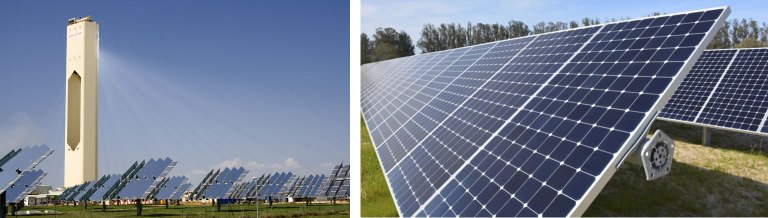
Concentrated solar power, shown on the left, captures heat from the sun and uses it to generate electricity. In a typical system, sun heats molten salt, molten salt makes steam, and steam pushes an electrical turbine. Alternatively, PV solar, shown on the right, uses silicon or thin-film material to convert sun directly to electricity.
Concentrated solar can be used to make things directly via heat, as discussed in Turning Deserts into Factories. This is important, since we need green heat that costs less than non-green heat to make materials; and creating heat via electricity is costly.
PV solar costs less than concentrated solar; however, concentrated solar can store energy more easily by placing already-hot salt in a tank. Also, when bad weather exhausts storage, one can burn natural gas or coal at a concentrated solar plant, to heat molten salt or steam. The additional cost to do this is low, since steam generators and other infrastructure is already in place. All one needs to do is add fuel, furnace, and spark.
Combining PV solar, concentrated solar, and carbon-based fuel is the lowest-cost way of getting reliable 24 hours-a-day 365 days-a-year coverage from the sun, and alleviating the need for companion carbon-based sources that turn on, when solar turns off.
The Ouarzazate Solar Power Station, pictured below, is an example of co-locating PV with concentrated solar.
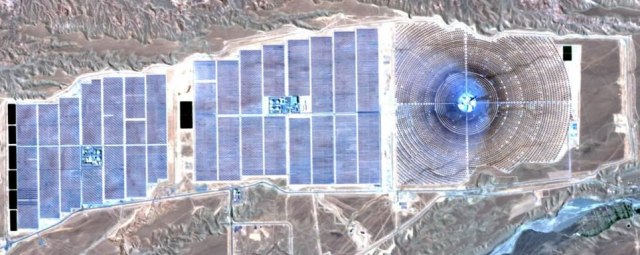
Figure 6: Solar Station
One can size PV solar to meet demand at noon, and size concentrated solar to make up the balance. For example, if you need 1 GWe total at noon, then $0.021/kWh ($0.67/Watt) PV solar would be sized at 1 GWe, and co-located $0.049/kWh ($1.41/Watt) concentrated solar with storage would be sized as needed. Concentrated solar would store at noon, and assist when PV solar did not satisfy demand. If 33% is PV and 66% is concentrated, for example, then average cost to customer would be $0.040/kWh ($1.16/Watt).
The above numbers are based on NREL‘s estimated cost of US solar for the year 2050 (Los Angeles – Mid). The $/Watt values assume each Watt runs at full power 5.3hrs/day (22%), on average, which is typical for the US South West. The resulting $0.040/kWh cost is similar to the current US cost of electricity from natural gas (NREL Gas-CC-AvgCF).
Solving the Climate Change Problem Exclusively with Solar Farms
The US South West PV solar farms currently produce electricity at a cost similar to that of natural gas ($0.040/kWh); however, this is only marginally helpful. Electricity from gas is dispatchable, which means you get it when you need it; and PV is intermittent. You cannot trade one for the other and get the same thing. You need to add concentrated solar with storage to get a dispatchable system, which could then replace a gas or coal fired power plant. According to NREL, combining PV solar with concentrated solar in the US South West costs $0.08/kWh (2021), and this is twice as much as electricity from gas. In other words, we need to drop today’s cost of concentrated and PV solar 2-fold, to beat carbon-based dispatchable electricity.
One can consider PV on buildings instead of PV on farms; however, the cost of PV on homes is typically 3 times more than PV on farms, and the cost of PV on commercial buildings is typically 2 times more than PV on farms, in units of $/kWh. Also, PV buildings heavily use transmission and external generation equipment when the sun sets. And maintaining this external equipment is costly. In theory, PV buildings should be charged for “storage”, since they store when they push/pull electrons to/from the grid, even if they are a net producer.
There are several things one can do to make solar farms more feasible:
- Reduce the cost of concentrated solar, as described in Turning Deserts into Factories.
- Reduce the cost of PV solar, as described in Mechanizing PV Solar on Land.
- Reduce the cost of transmission, as described in How to Reduce the Cost of Power Transmission.
- Set up federally regulated transparent solar farm zones, as described in Gov’t Needs to Think Big.
- Increase gov’t intervention in the solar industry, as described in How to Accelerate Green Energy Production.
Can we make distant dispatchable solar cheaper than carbon close to consumer? I believe we cannot answer this question without first spending millions of dollars on rough designs and cost models, to get a better sense of the numbers. And actually making it work would probably require tens of billions of dollars for automation engineering and factories.
Global Solar Farm Math
We will now run the numbers to see what it takes to solve the entire climate change problem worldwide exclusively with solar farms in deserts. In other words, we will calculate how much solar one would need to completely replace oil, coal and natural gas, worldwide.
We will use a simple model to make this easy to follow, and ignore issues such as energy consumption growth and different types of energy sources. Also, we will assume distant solar with storage plus transmission cost less than carbon options close to consumer. In other word, this is after we reduce today’s costs. If we do not achieve this goal, and solar farms supply 20% of world energy needs, for example, one would multiply the following numbers by 20%.
The world consumes 583 EJ/yr of heat energy (e.g. oil, natural gas, and coal), which corresponds to 56,000 TWh/yr of electricity when converted with a 35% efficient turbine (583e18 * 277.8 * 35% / 1e12). This corresponds to approximately 28,900 GWe of solar if it operates 5.3 hours a day at full power on average ((56,000 * 1e12 / (24hrs * 365days)) / (1e9 * 5.3hrs / 24hrs)). If one gets 140W per square meter for 5.3 hours a day, on average, this would correspond to 206,000 square kilometers of solar material, for example ((28,900 * 1e9 / 140W) / (1000m * 1000m)). If 30% of the facility is covered with solar material, it would require 686,000 square kilometers of land (206,000 / 30%).
If solar plus storage equipment costs $1.16/Watt ($0.04/kWh, 5.3hrs/day), for example, then total cost would be $33.6T worldwide. This works out to $1,121B per year if spread out over 30 years (28,900 * 1e9 * $1.16 / 30yrs). Costs for each country would be similar to what they spend on carbon-based systems: $182B/yr for USA (16%), $272B/yr for China (24%), and $161B/yr for Europe (14%). If green is cheaper than non-green, gov’t does not need to pay for this, since capital markets will lend.
The above numbers might seem high; however, they match the current costs of US electricity from natural gas ($0.04/kWh). With solar, one pays big when they initially build, and fuel is free. Alternatively, with carbon, one initially pays small, and then pays big over time for fuel. To compare these two, we look at the LCOE $/kWh electricity cost, which combines initial construction costs and fuel-over-time costs. The above $33.6T figure for solar corresponds to today’s cost of electricity from natural gas.
The world adds 131 TWh/yr of solar each year. If the world wanted to build enough solar over 30 years to match today’s energy consumption, it would need to increase solar production by a factor of 14, for example ((56,000 / 30yrs) / 131). This begs the question, “What would cause the world to increase solar production 14-fold?”
US energy consumption is 16% of world total, and Nevada is 286,000 square kilometers; therefore the US would need to allocate 38% of Nevada to offset total US energy consumption (686,000 * 16% / 286,000).
Many of the above numbers are gross estimates and could be off by a factor of two, in either direction, for a variety of reasons. We simplify to make this easier to follow.
If one wants to rework the above calculations with their own numbers, download our spreadsheet and view “Solving the Climate Change Problem with Solar Farms” within worksheet “Plan”.
It’s Too Big
The reader might consider the above numbers too big (because they are too big).
News reports on Hoover Dam, the London Array wind farm, and the Shouhang solar farm do not state how many are needed to supply world energy needs. Subsequently, the world does not grasp how much energy we get from oil, natural gas and coal. The short answer is “lots”.
If a world leader is wondering how to deal with this, I suggest they spend more time with the Henry Fords’ of the world. They are the only ones that know how to deal with large scales, which is what this is.
Too get a better sense of where deserts are located, one can consult Wikipedia’s list of deserts.
Conclusion
Gov’t does not need to pay for 206,000 square kilometers of solar material. Instead; they need to cost-reduce PV solar plus concentrated solar two-fold via factory mass production and automation; cost-reduce long distance power transmission; and then let markets do the rest. Also, after one country implements cost-reduction, they can give the engineering away for free, to decarbonize others.
The hard part is this requires that gov’t stop expecting others to do this, and instead be willing to spend money on cost-reduction engineering.
One can work with phases and verify feasibility with small money, before spending big. For example, $100M Phase I develops rough designs and cost models, $300M Phase II does detailed designs and prototypes, $1B Phase III builds demonstration facilities, and $10B Phase IV builds factories.
Unfortunately, four phases might take 10 years, since engineering takes time.
We do not know if far-away 24 x 365 solar plus transmission can be made cheaper than carbon close to user; therefore, gov’t should consider Phase I cost-reduction engineering to learn more.
NREL’s ATB model projects it will take 30 years to get PV solar and concentrated solar below the cost of carbon. However, if it takes 20 years to build large solar farms that replace oil, natural gas and coal; and we want to be at zero CO2 emissions in 2052; then we need concentrated solar to be cheaper than carbon in 2032 (2052 – 20 yrs).
In conclusion, gov’t needs to get more involved in reducing the cost of making electricity and materials with very large solar farms.