
The sun is setting on internal combustion engines (ICE). Many policymakers are now putting into law restrictions on the sale of new vehicles powered only by ICE
The sun is setting on internal combustion engines (ICE). Many policymakers are now putting into law restrictions on the sale of new vehicles powered only by ICE. These restrictions generate a lot of activity around hybrid systems, which combine ICE with some form of electrical assistance. In a mild-hybrid vehicle, the battery used can typically be charged by energy from the ICE. These so-called self-charging hybrids help consumers move over to electric vehicles while avoiding the issue of finding an electrical outlet to recharge the battery.
The balance between how much power comes from the battery and how much comes from the ICE determines just how “mild” the hybrid is. Larger batteries coupled to more powerful motors push the needle further toward the all-electric end of the scale. Full-battery EVs (BEVs) have no ICE and rely entirely on the electrical grid for energy. There are other issues associated with this, such as building up the public charging infrastructure needed to support the all-electric user experience. But for BEVs, there is no alternative to plugging in.
Other forms of alternative energy sources are being developed. One of the most promising is using hydrogen in fuel cells, which converts the energy stored in the hydrogen to electrical energy. This use will lead to fuel-cell EVs (FCEVs). While the energy is stored differently in BEVs and FCEVs, both produce electrical energy used to power a motor. Yet another technology being developed involves using supercapacitors to store electrical energy. A supercapacitor is similar to a battery in that it can be charged and discharged repeatedly, but internally, the differences are significant. Supercapacitors can be charged and discharged quickly, which means they are capable of higher power delivery than batteries, but the total energy stored is less.
Each of these technologies has its limitations. Batteries take time to recharge, fuel cells are slow to release their energy, and supercapacitors have low energy storage capacity. But they all generate electricity, the essential “fuel” needed by EVs. Perhaps in the near future, the term “hybrid” may evolve to describe vehicles that combine all three technologies to deliver the right user experience.
Range and rapid recharging are cited as reasons why consumers are reluctant to make a move to full electric. The automotive industry and the public sector must overcome that reluctance, without a doubt. By using batteries, fuel cells, and supercapacitors together, each technology has the potential to deliver energy when and where it is needed. For example, range concerns could be addressed by fuel-cell technology combined with fast-charging supercapacitors to provide good acceleration.
There are no known examples of this potential new hybrid class today. Still, it is one direction the industry could pursue in the future and is grounded in technology that currently exists.
Going wireless in automotive
Energy storage isn’t the only area of innovation within the automotive industry. Vehicles are becoming more connected, both with the general infrastructure and their on-board systems. In general, the amount of data generated by a vehicle is increasing exponentially. Wireless technology avoids the proportional increase in wiring required to support that connectivity.
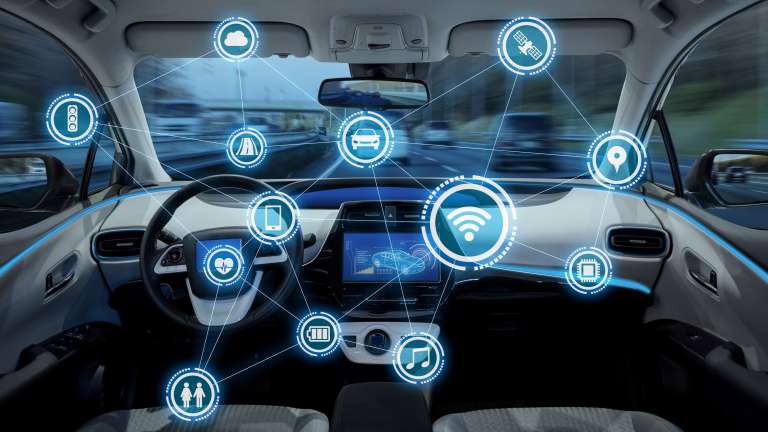
Wires are costly, heavy, and bulky. On the other hand, wireless connections are effectively weightless, but they do require careful design, and the antenna is one of the most critical aspects of the system. As vehicle manufacturers adopt more wireless connectivity types, at frequencies ranging from low megahertz to high gigahertz, antenna design and location are becoming more crucial. These design considerations will be more important as 5G connectivity finds its way into the vehicle, to provide mission-critical connectivity such as V2X and autonomous driving. The data infrastructure needed to support full autonomy will rely heavily on wireless technologies, including Wi-Fi and 5G.
Going wireless presents challenges, not least because vehicles are still predominantly made using large pressed-metal panels. It would be hard to replace metal entirely, but it is happening. Both glass and plastic are used more in automotive design and manufacture. Most types of glass and many plastics are transparent to radio waves. This transparency is excellent news for engineers developing electronic systems that use wireless connectivity. It also allows vehicle designers to explore new concepts. Entire glass roofs are becoming more common, for example. This design feature provides the option to mount antennas in the roof space that have clear access to the glass aperture.
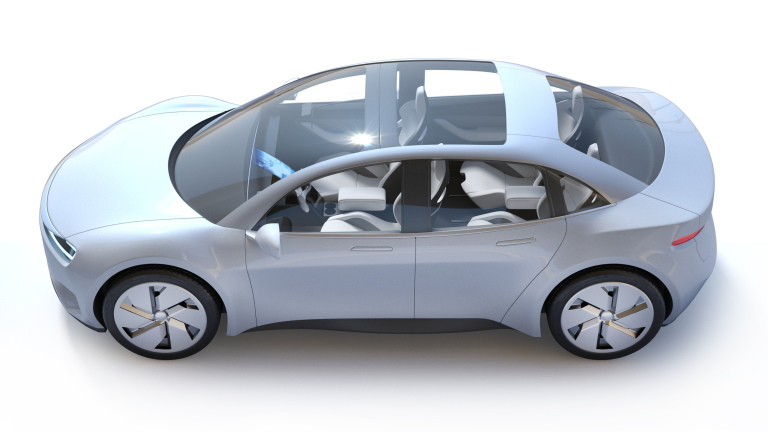
As the need for wireless connectivity increases, it may promote a new era of design that utilizes glass and plastic more. Of course, this also needs to be balanced with the need to design more affordable, maintainable, and recyclable vehicles.
In general terms, EVs are mechanically simpler than ICE-powered vehicles. This simplicity means they could be designed to last longer, be more easily serviced and maintained, and be highly recyclable. However, the electronic systems in EVs will be more diverse and, in the case of autonomy, more complex. The balance between power consumption, between the motive force and the electronic systems, will evolve, and this may also have implications on the types of energy storage systems employed.
Think autonomous, think up
Another major trend shaping the future of vehicle design, ownership, and utilization is autonomy. There is a growing correlation between ownership and autonomy; many believe that the first fully autonomous vehicles will be taxis and ride-sharing schemes. The economics support this theory; an autonomous EV will be expensive to buy but cheap to run, so to see a return, the owner will need a high utilization rate.
Most privately owned vehicles spend the majority of their time parked somewhere. It means the per-mile cost is high. Taxis and other service vehicles, on the other hand, spend most of their time being operated. Usage drives the cost per mile down and, if that cost has a markup, as is the case with a taxi, it moves into a positive return on investment.
One exciting area of research here is the autonomous flying electric taxi. It may sound like science fiction, but it is happening. There are good reasons why it makes sense, not least because many journeys are short and within congested cities. Flying through cityscapes would reduce the congestion at the road level. Several pilot projects are already in operation, and millions of research dollars have been spent making it a reality. In terms of autonomous operation, moving into the third dimension makes a lot of sense. There are no roads, buildings, or pedestrians in the sky, even at low altitudes. The sky gives autonomous vehicles a lot of freedom, with the only obstacles being other flying vehicles.
Moving into the third dimension will elevate the need for reliable wireless connectivity. Wireless technology is, by default, omnidirectional. Modern systems are more discriminative, using phased-array antennas and multiple in, multiple out to direct the RF energy and maximize the available bandwidth. Range may also be a consideration. Land-based transceivers in an urban area may never be very far from a 5G base station or equivalent, but air-based vehicles will be more distributed and dispersed. With fewer obstacles, the wireless signal should propagate further and suffer from less interference and multipath distortion. Air-based vehicles will also influence the way the systems are designed.
Supporting automotive innovations
There are several underlying technologies now supporting this level of innovation in the automotive industry. Wireless connectivity and antenna design are one. Wide-bandgap (WBG) semiconductor switches are another. These automotive innovations are where technologies such as silicon carbide and gallium nitride make a real impact.
WBG semiconductors generally offer higher efficiencies than regular silicon devices. The use of WBG semiconductors has several implications on the way power systems are designed. The central systems impacted include battery management systems and on-board and off-board chargers. Power inverters are used to turn DC from a battery (or equivalent) into AC to drive the motors. The efficiency of these systems has a direct impact on range. Developers can achieve higher efficiency by operating the power devices at higher switching frequencies. These frequencies have design implications on the passive and magnetic components used in the switching circuits; in general, they are smaller — both in size and value. The switching devices themselves are also reducing in size because they can operate at higher temperatures. The result is overall more compact systems.
As a supplier to the automotive, defense, and aerospace industries, the Yageo Group has a lot of experience in helping OEMs develop reliable solutions to all of the challenges outlined above. Many of those challenges are real today, even though some of the scenarios proposed are speculative. The direction in which the automotive industry moves needs the right enabling technology right now, which is where suppliers like the Yageo Group make a real and positive difference.