
This article explores how one could automate the installation of PV solar panels on buildings given a large R&D budget.
The average US resident pays $2.81/W to install PV solar panels on their roof; however, the panels themselves only cost $0.27/W wholesale in China. This means 90% of costs are for things other than panel manufacturing ($2.54 / $2.81).
The world currently spends $3.4T/yr on electricity generation and distribution, which works out to $100T if spent over 30 years ($3.4T x 30). Decarbonization entails replacing much of this with solar, wind, hydro and nuclear power. And some of this would be implemented with solar panels on buildings. If 5% was solar on buildings ($5T), and automation reduced this by 30%, for example, then automation would save $1500B. Therefore, it is reasonable for governments and/or foundations to spend billions of dollars to automate PV solar installation, maintenance, repair, customer acquisition, quotation, contracting, permitting, and design.
Solar Design 101
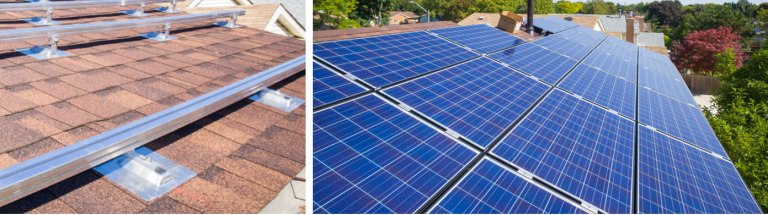
Solar panels attached to roof surfaces via brackets that do not penetrate the water barrier, as shown in figure 1. Electrical cables under panels carry power into the building and terminate at boxes of electrical equipment. These boxes enable the building to be either a net consumer, or net producer of electricity, with respect to the external grid.
Solar Economics 101
The average cost of PV solar in the US is $0.036/kWh from solar farms, $0.068/kWh from commercial buildings, and $0.107/kWh from residential buildings (NREL ATB 2021, PV generation, class 5, moderate). It might seem that solar on buildings does not have transmission costs; however, this is not accurate since buildings use transmission infrastructure when the sun goes down (i.e. they get electricity from carbon-based sources at night).
Solar on buildings is more costly than solar farms due to mechanical, electrical and contracting intricacies unique to each building. A solar farm with unused land nearby can install an additional solar panel at low incremental cost. For this reason, consumers without solar would prefer to buy electricity from a solar farm at $0.036/kWh, than to buy from a building with solar panels at $0.107/kWh. However, if land is in short supply, and roof space is readily available, then solar on buildings becomes more attractive.
Electricity from US natural gas typically cost $0.04/kWh wholesale. Subsequently, one might conclude that a PV solar farm at $0.036/kWh costs less than carbon-based electricity. However, this is not the case since the carbon-based facility has already built and paid for. For this reason, the cost to the consumer increases when an intermittent green source is added to an existing carbon-based system.
The US currently has 40% of its electricity generated from green sources (19% nuclear, 7% hydro, 3.3% solar, 9% wind). If this was increased to 85% via $0.036/kWh PV solar farm and land-based wind farm, then the cost to consumers would increase ≤ $0.02/kWh. In other words, decarbonizing most of electricity is somewhat easy. However, 58% of energy is not electricity (e.g. transportation, making chemicals and materials), and it is not clear how to decarbonize non-electricity at low cost.
Constructing Solar and Wind Power until Saturation
The world has over 512 cities with more than 1 million people. One could simplify each as having three elements: (a) urban buildings that consume electricity and have no space for solar, (b) suburban buildings with PV solar, and (c) PV solar farms outside the metro area. And each metro area has different quantities of each element. For example, Las Vegas has plenty of land for PV farms, whereas land around Taipei is needed for agriculture. And Houston is mostly suburban, whereas Hong Kong is mostly urban.
Typically, a US resident with solar panels will receive $0.13/kWh (average US retail generation transmission) for electricity generated for itself, and only receive $0.034/kWh for electricity that it generates for neighbors. In other words, there is often little incentive to power the urban center with a roof fully covered with solar panels. Put differently, a home owner might install solar at a $0.107/kWh cost, and then use the panels to avoid buying from the grid at $0.13/kWh (i.e. solar provides $0.027/kWh benefit). However, when a building sells excess electricity to the grid, the power company often only pays $0.034/kWh since they can buy at this price from other sources. Therefore, the homeowner does not have incentive to fully cover their roof, only install panels for themselves.
We will now describe a hypothetical scenario that explains why power companies are reluctant to be more generous with producers of green electricity. Suppose we magically cover half of a metropolitan area’s buildings with solar panels, to the point where they generate the same amount of energy that they consume over a year, with a $0/yr electric bill. If this occurred, then the other half of the metro buildings would see their electric bills approximately double, since they would be shouldering the cost of the existing carbon-based infrastructure instead of sharing. And a big cost increase would be politically unpopular.
One might want to build up solar and wind power around each metropolitan area until supply exceeded demand when both sunny and windy. After reaching this “saturation”, the area would become reluctant to build more solar and wind power, since energy was being discarded. In many cases, this saturation would occur after 80% to 90% of electricity was generated from green sources. Reaching saturation is a worthy goal for all metro areas, and is the first phase of decarbonization, as we discuss in A Plan to Get to Zero CO2 Emissions.
What does it take to Drive Full Coverage of Solar on Buildings, Edge-to-Edge?
To drive full coverage of solar on buildings, until a metropolitan region discards electricity at noon due to saturation, one needs to satisfy the following conditions:
- Cities sign Power Purchase Agreements (PPA) where they agree to buy a specific amount of electricity at a specific price from a carbon-based supplier. When a metro region adds solar, it needs to reduce the output of the carbon-based source, and replace with green electrons, as they become available. In many cases, this requires changing the previously signed PPA. And to do this, many nations need new laws, as discussed in How to Accelerate Green Electricity.
- Buildings that install solar are typically looking for a payback period of 5 to 12 years. And this applies to additional panels that enable the building to be a net producer of electricity.
- Gov’t intervention is needed to require consumption of greener and more costly electricity. This typically results in a cost increase to net consumers, and is often politically acceptable if kept small (e.g. ≤ $0.02/kWh increase). In other words, we do not want net consumers in the urban center to see a price increase of more than approximately $0.02/kWh, even if half the metropolitan customers have become net producers. Otherwise, net consumers will politically block gov’t intervention that causes their electric bills to increase excessively.
- Net consumers in the urban center prefer to buy cheap electricity from PV solar farms (e.g. $0.034/kWh) than to buy costly electricity from building-based solar (e.g. $0.107/kWh). To be more competitive, building-based solar needs to reduce cost, perhaps 2 to 3-fold.
Notice that 3 out of 4 items above conditions involve reducing the cost of solar on buildings.
This can be done with automation, and since the world is looking at spending trillions of dollars on building-based solar over 30 years, it makes sense to spend billions of dollars to reduce that cost.
We will now review ten things engineers might do with a large solar automation R&D budget.
1) Develop Standards that Help to Automate PV Solar Installation
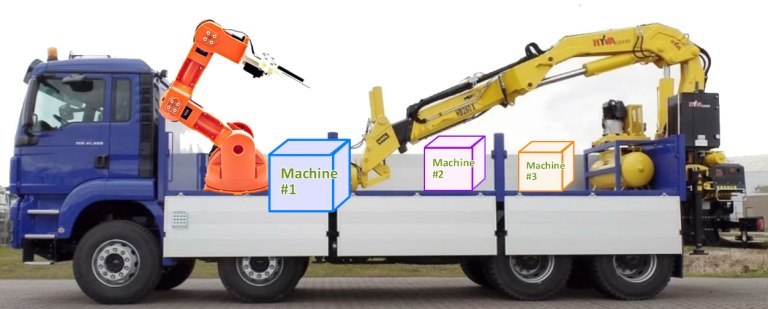
Engineers could develop a standardized system for attaching machines to the end of an articulating arm, as shown in figure 2.
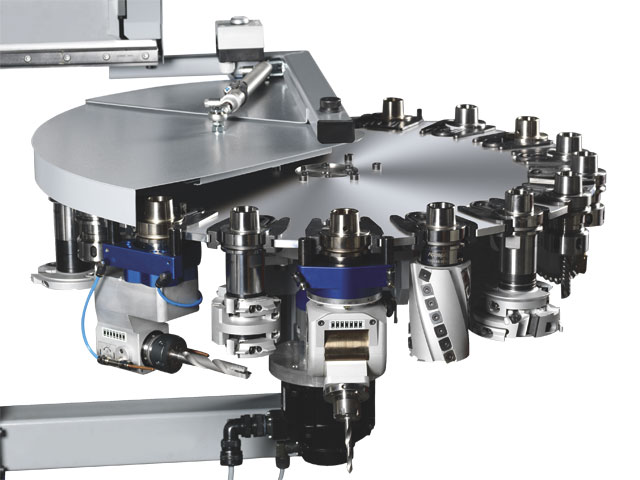
Pictured in figure 3 is a tool exchanger for a milling machine that utilizes one tool at a time. A similar approach could be applied to a truck mounted articulating arm, or industrial robot.
Currently there are machines that automate the laying of bricks, as shown in this video. Machines that install solar panels might be similar; however, solar needs to deal with many unique structures, whereas a brick layer starts with a known flat surface, and therefore requires significantly less software.
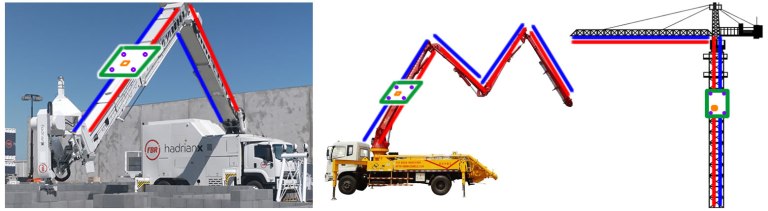
One could move solar panels and metal framing from a truck to the roof via standardized rails on cranes, booms, and articulating arms; as illustrated in figure 4 in red and blue color.
A motor mounted on a tram could interface with a linear gear and provide propulsion, as illustrated below-left in figure 5. A standardized mounting plate, below-right, on top of the tram could interface to machines in the same way machines interfaced to the end of an articulating arm.
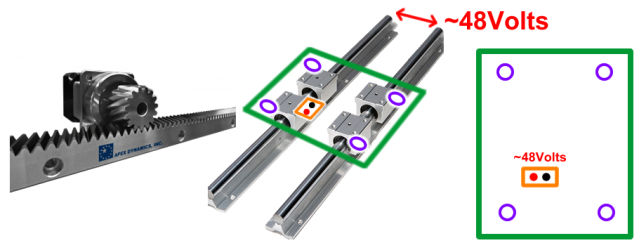
Machines on trams might focus primarily on material transport, whereas machines at the end of articulating arms might focus on installation. For example, one might place a hopper with a stack of solar panels on a tram, and attach an industrial robot to the end of an articulating arm. For details, see Automating Solar Panel Installation.
The rails could be electrified by a ground-based truck with a low voltage such as 48VDC to improve safety against shock. This could provide power to trams, machines that attach to trams, and machines that attach to articulating arms.
When working with a large commercial roof, one could move a machine to any location via a truss, as illustrated in figure 6. This could help move metal framing, assemble framing, move solar panels, install panels, and clean panels.
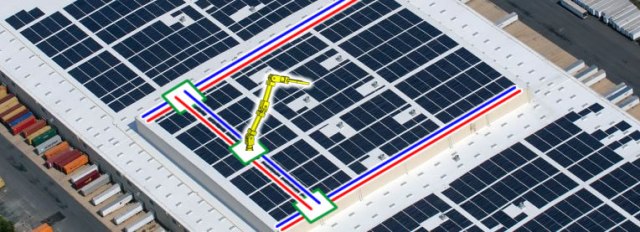
Manufacturers of articulating arms and cranes could upgrade their equipment to support this system without too much effort, since they could just attach rail hardware, add power, and let the trams and machines do the work. Machines could focus on their specific function while delegating movement to articulating arms and trams. Also, trams could operate in parallel along one rail-line.
To get this to work, engineers could develop mechanical, electrical, and communications standards that define rails and mounting plates. They could support multiple sizes, since some applications would involve small loads and others large (e.g. 25kg, 100kg, 400kg, 1500kg, 6,000kg, and 25,000kg).
Engineers could develop standards that define how trams, machines, sensors, cameras, and control actuators interface to a central computer. Software could receive images from cameras and calculate a database of objects. If an object was moving, a velocity vector could also be calculated. High level software could scan the object database, and make decisions.
Don’t expect a company to fund this development, since one missing element will block revenue. Also, a company cannot afford to develop standards that benefit others. Instead, they would favor a proprietary system that they own; however, developing this themselves would probably be overwhelming.
Warning: Automated construction might lead to more construction, more material usage, more energy consumption, and more CO2 emissions.
2) Develop Factory-Made Solar Kits that Support Automated Installation
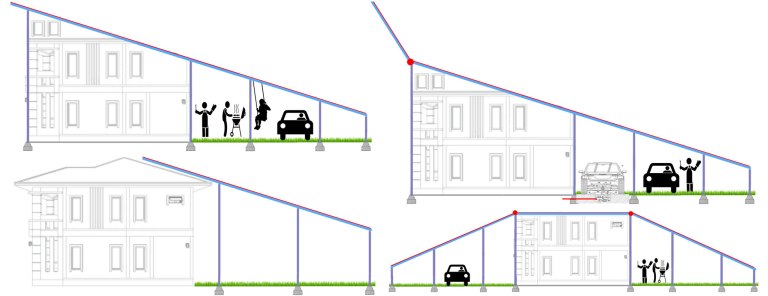
Many metropolitan areas do not have enough roof surfaces to power the entire metro region with solar. For this reason, engineers could develop factory-made kits that support more panels, as illustrated in figure 7.
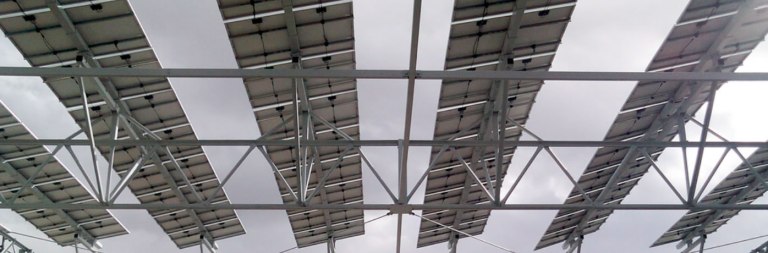
To reduce costs, engineers could minimize material used by framing, as shown in figure 8.
To automate the installation of framing and panels, one could stack large factory-made sub-assemblies into a shipping container (e.g. each 0.5 x 2.5 x 10m), transport to site, and then use a crane-assisted machine to join sub-assemblies, as illustrated in figure 9. Truck with shipping container, crane, and dangling machine could all be coordinate by a common computer.
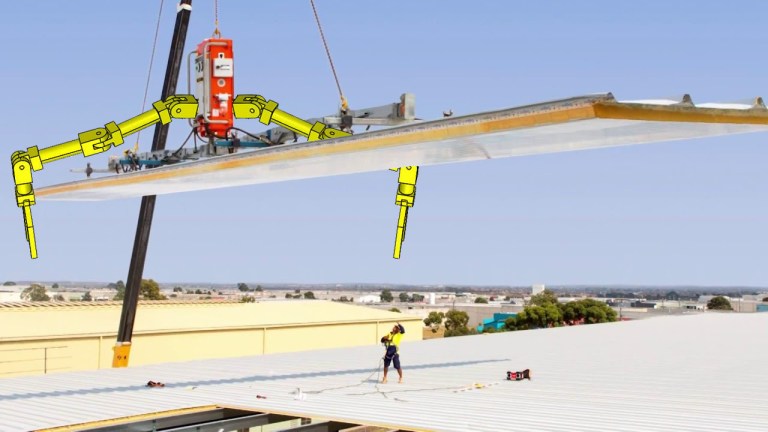
Motors could pivot panels toward the sun, to increase the amount of energy that is gathered. Also pivoting could help avoid wind, hailstones and snow. Wind traveling 160kph pushes 244 kg against each square meter of surface area. For example, 160kph wind pushes 31,700 kg against a 13 x 10m surface (13m x 10m x 244 kg/m2). For this reason, pivoting can be helpful in a storm.
Making this work economically is a big challenge since safe overhead structures tend to be costly. The good news is that engineers could do rough designs, calculate costs, and build prototype structures by hand without spending significant money.
Designing the structures themselves is somewhat easy. However, designing the mechanics of the automated installation machines might be ten times harder. And even harder still, perhaps another factor of ten, would be writing software that controls the machines. In other words, automation requires a significant R&D budget.
3) Develop Factory-Made Carports with Automated Installation
Engineers could do the same as above, yet with factory-made carports that are assembled by automated machines, as illustrated in figure 10.
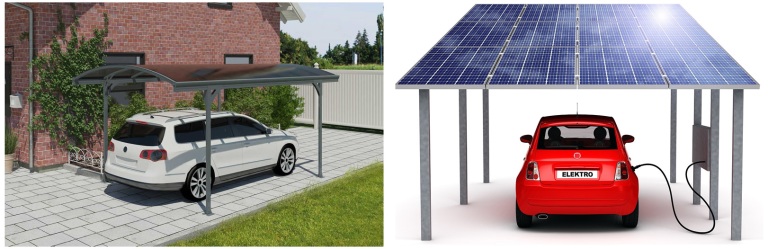
To automate the placement of foundations, a truck under computer control could drill holes with an auger and drop in preformed concrete foundations, or pour concrete, as illustrated in figure 11.

4) Reduce Cost of Oversized Roof
A house needs many solar panels to be a net producer of electricity, especially if using electricity for heat in a cold climate. Subsequently, one might consider an oversized roof, as illustrated in figure 12. This concept, by architect John Meyer, illustrates a 1:1 ratio of floor space to solar surface (i.e. both are 185m2). If one examines this carefully, they can see that half the roof is not above the structure.
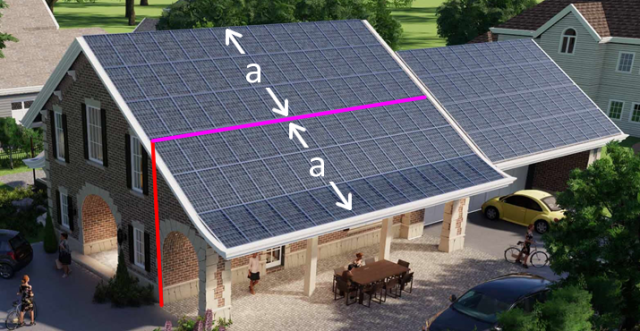
In this concept, the sun-facing roof is elongated 2-fold, and supports 112 panels that are each 1.7 x 1m in size (360W/panel). Total generation is 40kW when facing the sun. This works out to $7100/yr generation @ $0.13/kWh, $60k system cost @ $1.50/W, 360W/panel, 55000 kWh/yr, and 6.3 kW average over a year. This produces 5-times more electricity per year than that consumed by the average American home. However, one needs more than average when using electricity for heat, and when powering friends in the urban center.
Making an oversized roof economically viable is a challenge since large structures, similar to that shown here, tend to be costly. However, engineers might be able to make this work financially by extending a traditional roof with light factory-made framing; or making a roof structure out of pre-fabricated modules supported by automated assembly, and automated design.
5) Develop Automated Marketplace Software
Customer acquisition involves a building owner calling multiple suppliers, visiting with several, and selecting one. This typically consumes time of supplier and customer, and time is money. To reduce this cost, software engineers could develop websites that automate design, customer acquisition, contracting, scheduling and permitting.
This falls under the broad category of “automated marketplace”. Examples are Uber, Airbnb, and Xometry. In theory, any of the above discussed solar-based mechanical systems could be supported by an automated marketplace website.
For example, a homeowner could type their address into a website, see a satellite photo of their driveway, and select one of several carport options. They could click to generate a free pdf report with mechanical drawings of the carport, foundations, electronic boxes, and power cabling. And click again to buy and schedule installation.
Another website could allow one to enter an address, see a satellite view of the roof, and specify the number of solar panels for installation. Computer generated drawings could then show panel placement along with other pertinent information.
Computer programmers could build prototype websites without touching a solar panel. Also, they could make their code available to others, free and open, to encourage others to build on their work.
6) Develop Software That Connects Existing Data to Automated Marketplaces
The above discussed automated marketplaces would need information on buildings, such as photographs, 3D models, and architectural drawings. They would want data in a common format, and want it for all buildings. The following sources meet these conditions; however, their accuracy is lacking:
- Google Street View maintains photographs taken from the street.
- Google 3D calculates 3D models of buildings and trees based primarily on satellite imagery. To see how this works, visit Google Earth and enter an address into the search field.
Cities maintain architectural drawings for all buildings; however, their data files are in different formats, if available digitally. Cities also maintain information on underground and above ground infrastructure, in different formats (e.g. water pipes, power wires).
Programmers could develop software that converts data in different formats, to a common format, for marketplace software. This interface software could be free and open, to encourage utilization, and to help cities control interfaces due to concerns over how they are used.
7) Develop Aerial Image Collection System
Programmers could also develop systems that take aerial photographs of land from UAV’s, helicopters, and airplanes.
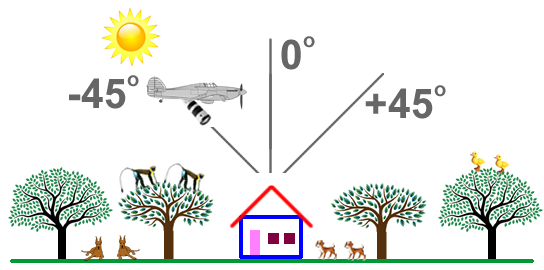
The 150 largest metropolitan areas in the US contain 75% of population and one could potentially photograph these with one small airplane over the course of a year. A telephoto lens with a high resolution camera at low altitude (e.g. 1km) could take pictures with a pixel size several cm across. These pixels could be 50 to 1000 times smaller than that in the typical satellite image, in terms of surface area (e.g. 10 vs. 1600cm2). Also, an airplane could take multiple pictures of the same object, from different angles, with the sun always approximately parallel to the camera lens to reduce shadow, as illustrated in figure 13. In the below concept, land is photographed three times: -45° in morning, 0°at noon and 45° in afternoon. Also, one could take pictures from angles that show shadows, or take pictures when the sun is obstructed.
If one photographed 150 metropolitan regions, each 50 x 50km in size, with 3 bytes per 3 x 3cm pixel, supporting 5 different angles, then one would need 6250 TB of storage ((150 regions x 5 images x 3 bytes/pixel x (50e3m^2) x (100cm/3cm)^2) / 1e12 bytes). If one stored these on 4TB hard disks, and each disk cost $100, then one would need 1560 disks for a total disk cost of $156K.
An airplane could take pictures with multiple cameras simultaneously that point in different directions, and support different spectrums. For example, an infrared camera that detects heat could be used to identify faulty solar panels and poorly insulated buildings. Also, programmers could calculate 3D Models of objects, given images from different angles, and other sources of information.
In summary, an initiative that maintains accurate images and 3D models would help automated marketplaces, at relatively little cost.
8) Develop City-Wide Solar Panel Distribution Program
As noted above, solar panels cost ~$0.27/W in high volume in China, and cost ~$1/W in low volume outside of China. To help reduce panel costs outside China, computer programmers could develop software that helps a city buy solar panels from China in high volume and then sell them to local installers at a low price, via an automated website-based system.
Shipping containers full of panels could be delivered to a parking lot where a city keeps their equipment. Solar installers could pre-pay at a website and collect panels at the shipping container, overseen by a trusted individual. Subsequently, cities could drive down the cost of solar, and make it easier for buildings to cover their roofs edge-to-edge. The disadvantage would be reduced selection; however, installers might appreciate having one low cost option.
Programmers could write software, set up a prototype in one city to ensure the system is functional, and make their software available free and open, to encourage cities worldwide to reduce the cost of solar panels.
9) Develop City-Wide Solar Panel Installation Program
If a city, power company, or solar company has access to design software, photos of buildings, and stacks of $0.27/W panels, they might consider pushing this one step further and installing solar panels themselves. Building owners could entering into an agreement where they rent their roof in return for a benefit, such as cash.
Engineers could explore interfacing the solar panels to the power grid via a box of electronics that attaches to an external wall surface, near where power enters the building from the street, as illustrated in figure 14. This would allow one to install and maintain without entering the building. Engineers could develop this box of electronics and set up a communication system between it and an external server.
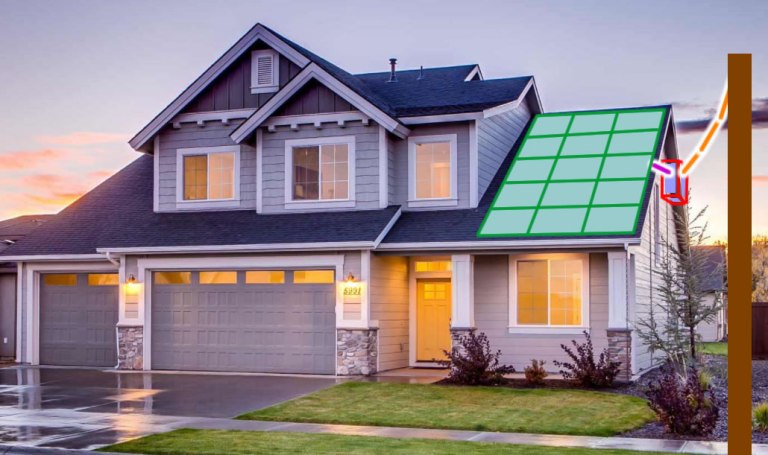
Programmers could develop software that provides a website user interface for building owners, maintains a list of assets (e.g. solar panels), communicates with solar electronics, and directs automated equipment to install and maintain. Programmers could set up a prototype system in one small city to ensure software was functional, and publish source code to encourage worldwide utilization.
10) Develop Standardized Solar Electronics w/ Monitoring and Communications
For relatively little money, electrical engineers could develop a standardized communication system between PV solar electronics and external servers. This could help automate PV solar installation, maintenance and repair.
Additionally, standardized communication could help identify failed or failing equipment, and help understand component longevity. More specifically, one could monitor voltage, current, power, efficiency, vibration, sunlight, wind, water ingress, and temperature (PCB, atmosphere, solar panel). Implementation could involve designing electronics that attaches to solar panels, building prototypes, and making all designs available to the public at no charge to facilitate standardization.
If a power converter box of electronics is advertised as supporting 600W of power, for example, and one runs it in the desert at 600W, it probably will either power off due to excess temperature, or will incur permanent damage within 30 days. In other words, one often needs to run electronics at less than advertised power. Alternatively, a free and open design could include detailed component analysis that models failure as a function of power load and temperature. For example, instead of claiming “600W”, a graph could plot mean-time-between-failures (MTBF) vs. atmospheric temperature, for power levels 100W, 200W, and 300W (i.e. 3 plots in an X-Y graph).
Longevity is a function of load power and external temperature, and could be documented in a datasheet. However, this is seldom done since competitors are pushed to exaggerate capabilities, and to reduce costs at the expense of longevity. On the other hand, buyers sometimes need to understand longevity in order to control lifetime costs. For this reason, there might be a demand for open designs that include accurate longevity data.
Conclusion
Automating the installation of solar panels on buildings would not be easy due to significant software challenges. However, engineers could push forward given a large R&D budget. A company could not afford to fund this, for several reasons, as discussed above. Subsequently, foundations and/or governments would need to step up. R&D that reduces the cost of green energy is probably the lowest cost way for governments to tackle climate change; therefore, they should consider automating solar installation on buildings, even if it costs billions of dollars.